
Design Between the Covers: Dennis Miller’s Art + Furniture
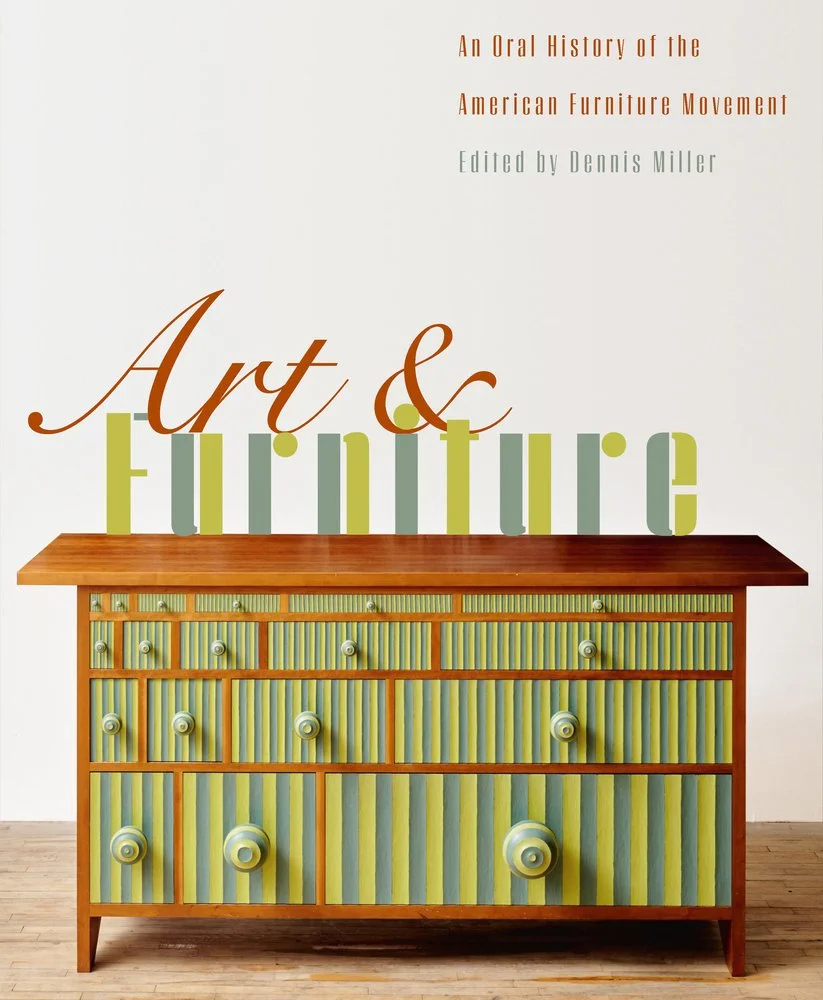

NYSID’s “Design Between the Covers” series delves into the thinking behind design books. This installment explores Dennis Miller’s Art & Furniture: An Oral History of the American Furniture Movement, published in November 2026 by Abbeville Press.
In addition to being a board member of the New York School of Interior Design, Miller is an architect, a gallerist, and the founder of Dennis Miller Associates, a showroom that was pivotal to the American Art + Furniture movement. During the COVID-19 pandemic, Miller set out to record the movement's oral history, interviewing its leading artists and makers, as well as the curators and gallerists who championed their work. The book–a glossy, gorgeous compendium of America’s most important art and studio furniture accompanied by the words of its makers–grew out of Miller’s oral history project. Miller donated the complete oral history to NYSID’s Archives & Special Collections, where it will remain available to scholars in perpetuity.
This article is an edited and shortened excerpt of Miller’s Nov 12, 2026, book talk at NYSID, where he was accompanied by Thomas Mellins and Donald Albrecht, curators of NYSID’s exhibition Art + Furniture: Designers, Makers, and Advocates, based, in part, on Miller’s scholarship. You can see the exhibition, which remains open in the NYSID Gallery at 70th Street, until Friday, April 2, 2027.
NYSID: Will you tell us about your involvement in the Art + Furniture Movement and what inspired you to create this book?
Dennis Miller: (As an architect), I became acquainted with the American Craft Movement and also with a design movement of radical furniture in the United States, mostly based in New York, during the 80s and 90s. In 1984, I started a furniture showroom, and this showroom was dedicated to the work of emerging artists, whether they were craftspeople or artists making furniture. I envisioned it as something that was an alternative to mass-produced manufactured furniture coming out of the United States and Europe. . .Postmodernism was starting, and this takes us to a time in New York when creativity was becoming rampant. There was a decline in the economy. There was a movement in New York that encouraged creativity in the arts, in music, in dance, theater, and particularly in design. And there were elements that made it possible for people to create objects, to make them, and then try to find ways to sell them. And so, in doing this oral history, I wanted to look at what was going on at that time. Why were these people making this work? What did they do to try to find a way to sell it? Who was promoting it? And most importantly, what has happened to them?
If someone didn't capture this (design history), maybe it would be lost. So I'm very much involved with trying to (distill) this legacy and make it available to others. That's why I think the New York School of Interior Design Archives is a really terrific place for it.
Who started the Art + Furniture Movement?
I didn't interview Warren Esherick, but he's an important place to begin. Warren Esherick created work from the 1920s through the early 1970s. He's known as the father of studio craft furniture. He plowed the ground and planted the seeds. . . I'd never thought of making furniture until I discovered Escherich's work. I hope everyone will give careful consideration to doing what they can to preserve and maintain his studio, the Wharton Esherick Museum, a national treasure in Pennsylvania. So we have a piece by Wharton Esherick, and another person who was instrumental to starting the movement, George Nakashima, a Japanese American who lived in Pennsylvania. There are others, like Sam Maloof, Wendell Castle, and Gary Knox Bennett, who fall into that first generation of the movement.
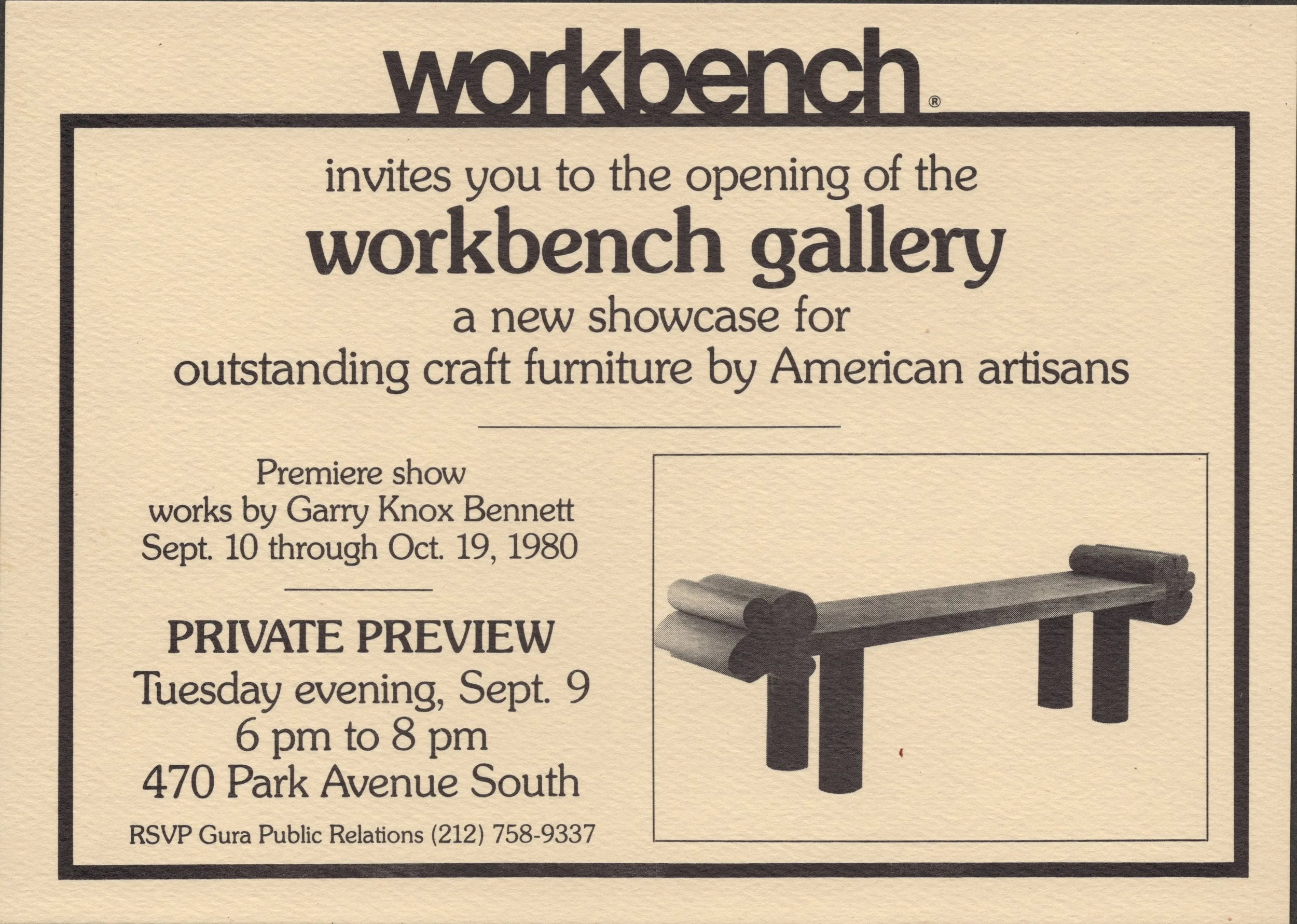
Workbench Gallery Opening Invitation facsimile (1980).
Courtesy of Dennis Miller.
Will you tell us about some of the makers, curators, and gallerists who defined this movement?
We come to a more evolved period, starting in about 1980. Studio makers were interested in creating craft furniture, in creating objects that could be appreciated for their workmanship, for (the makers’) knowledge and ability to use materials and equipment to make beautiful objects. One of the first places in New York that wanted to show this work was the Workbench Gallery. The Workbench Gallery was a small space underneath a store called the Workbench, a high-design, mid-range gallery of mass-produced furniture for people who had a certain sense of style. The gallery represented work from different artists, and what was unique about the gallery was they never charged a markup for the furniture, so that the artists who made the furniture benefited from the full price. The gallery . . .was instrumental in presenting this work to New York.
Wendell Castle was not part of Workbench Gallery, but was an artist who, coming from Kansas, saw himself first as a sculptor, and then he decided some of the sculptural work could become furniture. Then, he moved to Rochester and taught at the Rochester Institute of Technology and had a program in which many of the artists whom we'll meet studied. Wendell Castle became the dean of American studio furniture making. He transformed what he did from making furniture objects, such as the dictionary stand, which were usually one-of-a-kind, or very small editions, into one-of-a-kind sculptures. He continued working in multiple materials. He worked in bronze, in plastics, and continued until his death in 2018, showing at Friedman Benda Gallery in New York.
We also saw in the late 80s and 90s an interesting appreciation of modern furniture, of modern design, and the show Design 1935-1965: What Modern Was, which was at the IBM Gallery, and was an important compendium of design. Some of the objects in the show were mass-manufactured, to be sure, but it chronicled, from a period of 1935 to 1965, what design was doing. Through this show, (the movement) found a great friend and champion, Kate Carmel, one of the curators. She later became a curator at the American Craft Museum, now the Museum of Arts and Design, and really promoted design furniture, studio furniture. It was Kate’s observation that it was very difficult for museums to be interested in collecting art and studio furniture. That was part of the challenge that woodworkers and studio makers found. They had to find a place to sell their work, but they also wanted to be appreciated as art.
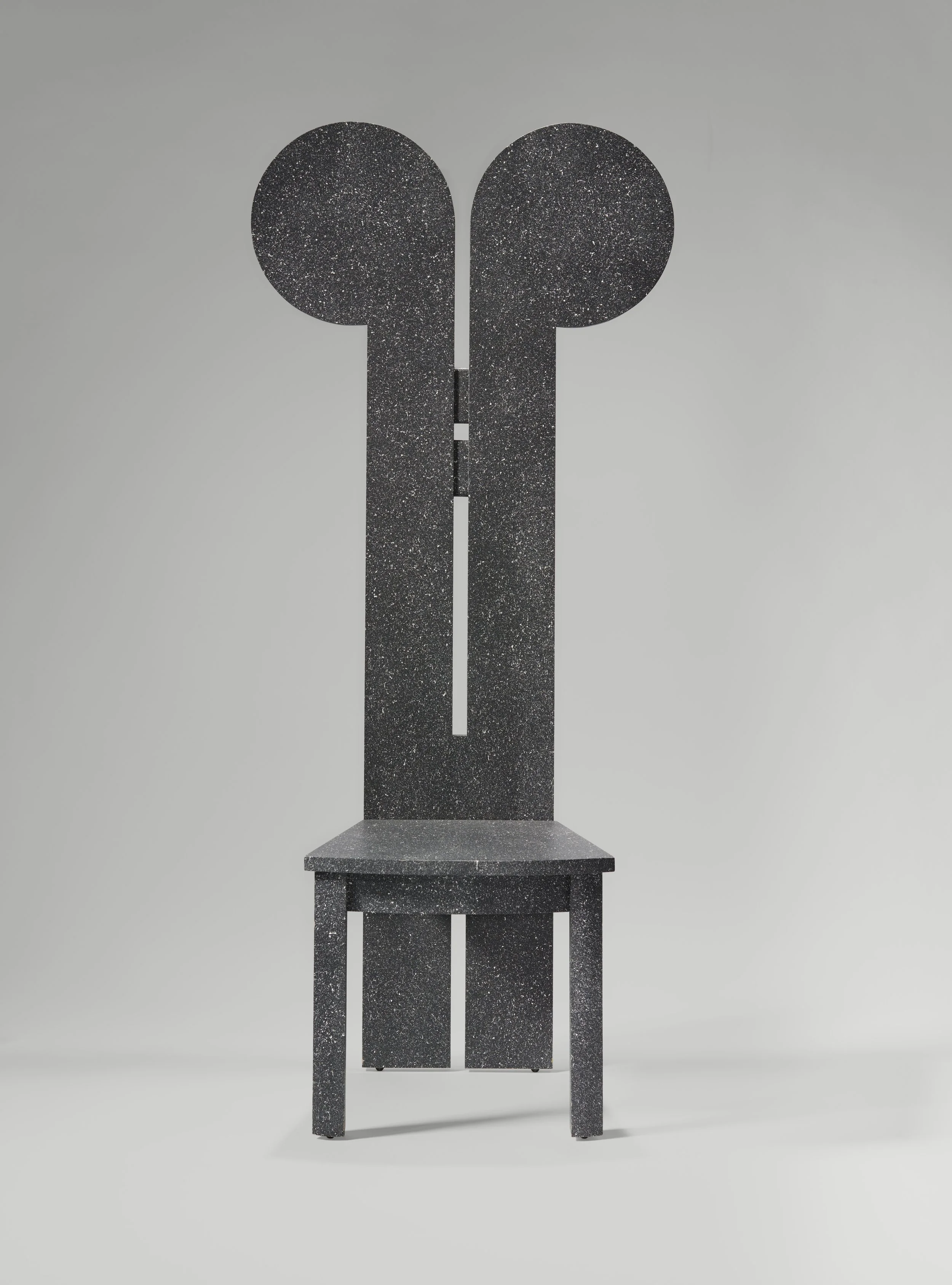
Mickey Mackintosh (designed 1981; executed 2022) by Wendy Maruyama.
Courtesy of Abbeville Press.
Wendy Maruyama entered this field as a studio maker in the late 70s. She created the Mickey Mackintosh Chair in 1981, and in this object you can see in it her sense of humor and knowledge. What makes this chair so important is that it references the work of Charles Rennie Mackintosh (1868 – 1928), but it also reflects its own time, visually referencing Mickey Mouse. It was very difficult for these designers to find a place to sell their work and to make a living. Often, they would resort to teaching. Wendy has been, for the last 30 or 40 years, a teacher of studio making, which has helped her career. There were programs that specifically geared themselves toward young makers who wanted to learn the craft, to learn how to make their furniture available to places that would sell it. A program in artisanry existed at Boston University for a time. There is a picture, which we were very happy to find, of the (BU) students at that time, probably 1980, and a lot of them we can identify and are in this book, which was really delightful.
Programs in artisanry were very important. (Graduates of these programs) went to East Hampton and showed in Pritam and Eames, which became a primary selling place for studio furniture. The owners (Bebe Pritam Johnson and Warren Eames Johnson) were completely devoted to their artists: they supported them, they entertained them, they promoted their work. East Hampton was a difficult place to find a big audience, but it was an audience that had a lot of money. Rosanne Somerson came from the Rhode Island School of Design, where she started in industrial design, and they didn't have a furniture-making program, but she eventually developed it, and subsequently became the president of the school. She has a very robust career. Judy McKie is another of the artists who was with Pritam and Eames, who probably has the biggest resale value following today, and (her success) is something that's critical to this movement. It was a movement that existed in the 80s and 90s up until the early 2000s, when values were quite high, and they were put quite high from the various galleries, but in the resale market and in recent days, unfortunately, we've seen quite a diminution in value, and this is very disheartening to a lot of the artists who I spoke with. But Judy's work retains very high values.
Thomas Hucker is someone who was also at Pritam and Eames, and we're happy that he is a furniture instructor here at the New York School of Interior Design. I met Rick Wrigley in the early 80s, an artist who was also at Pritam and Eames, and has really exited from the career of making furniture, as many of these people have. It's very difficult to maintain studios to find assistants who can be valuable in this. Rick has found a career making sculpture and doing real estate investment, but is very valued as a furniture designer. Richard Scott Newman still creates some things, but has moved away from making furniture. I believe he's making banjo parts with the knowledge he has of wood. Silas Kopf found a different route. He was very interested in Art Deco furniture and Art Nouveau furniture, and decided he would study marquetry. He's one of the few who are known for using this technique in his furniture, and he's beloved for that. Tom Loeser is one of the artists that's most intriguing because he straddled this world of fine studio making and radical art furniture, and worked in galleries that showed both kinds of work. I was very pleased that we were able to use one of his pieces for the cover of the book.
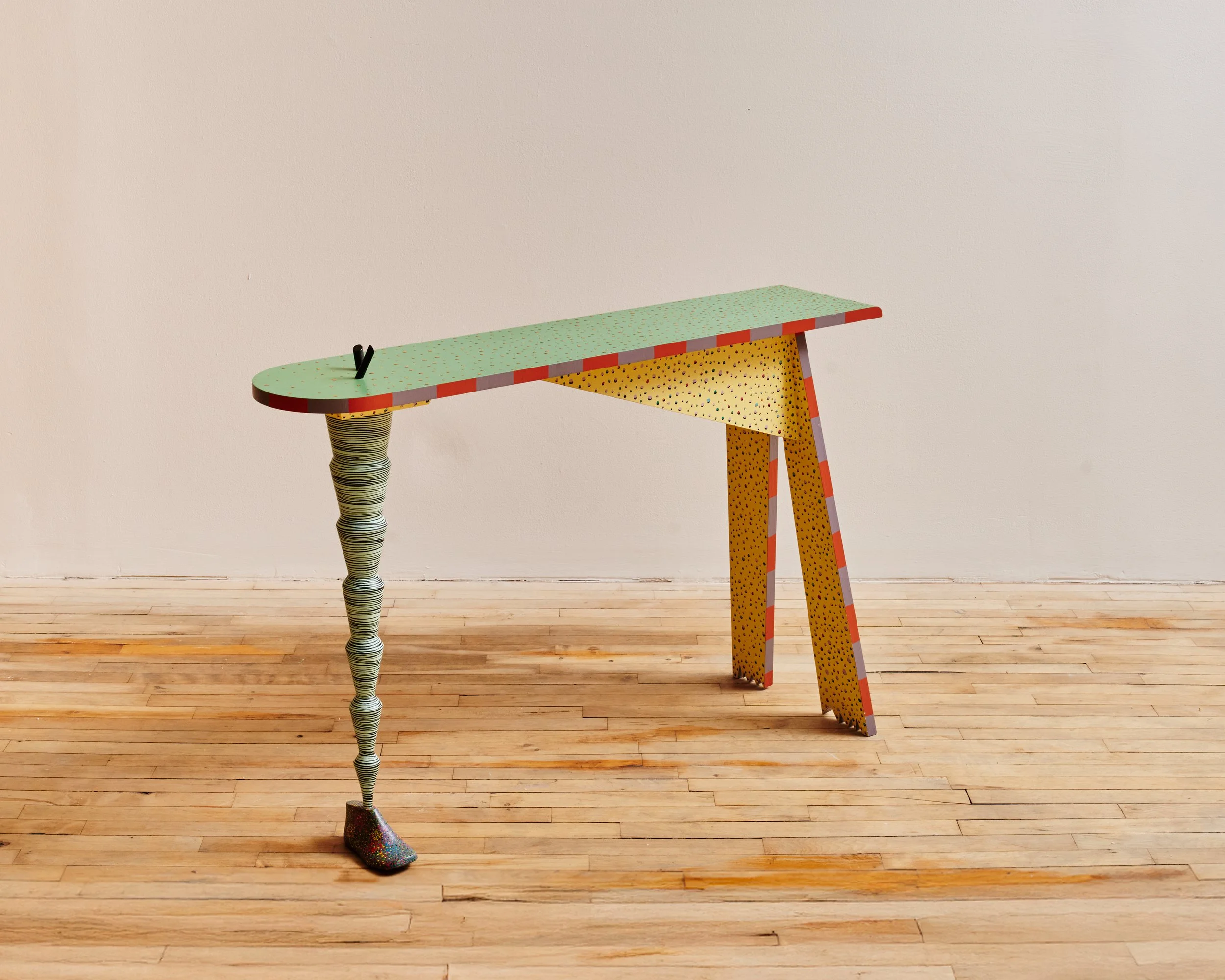
Table with Foot (1984) by Tom Loeser.
Photo credit: Matthew Gordon.
Courtesy of Superhouse and Tom Loeser
So when New York became very hot in the art world in the early '90s, when we saw a proliferation of new art galleries, there entered into the scene a person who had been collecting for many years, Peter Joseph. He lived in East Hampton, and he was one of Pritam and Eames’ best customers. In fact, he would go there every Sunday, and he would buy something. . . . He was an investment banker. He was interested in presenting the world of studio craft, and he created a gallery, and he did it uptown, which was very unusual. Most of the galleries were in Soho or downtown. Peter wanted to create this world where this furniture was art, and to do so, he went to 745 Fifth Avenue. He took a gallery next to Mary Boone, and he presented this work of all these artists, many of whom were at Pritam and Eames. And he raised the prices and made it possible for these artists to have one-man shows. And he produced beautiful catalogs and beautiful essays promoting this furniture…. Peter had a broad range of artists who worked with him. Most of them were studio craftspeople working in wood, but he also had Gaetano Pesce.
Art et Industrie was the place that put art furniture on the map in New York. . .It was very important because it influenced a whole generation of makers afterward. It came about because New York was a place of creativity. Then New York was a place where young people could come without a lot of money. They could establish themselves here. They could make work, and they could show it. Rick Kaufmann at Art et Industrie was the most important person to show this work.
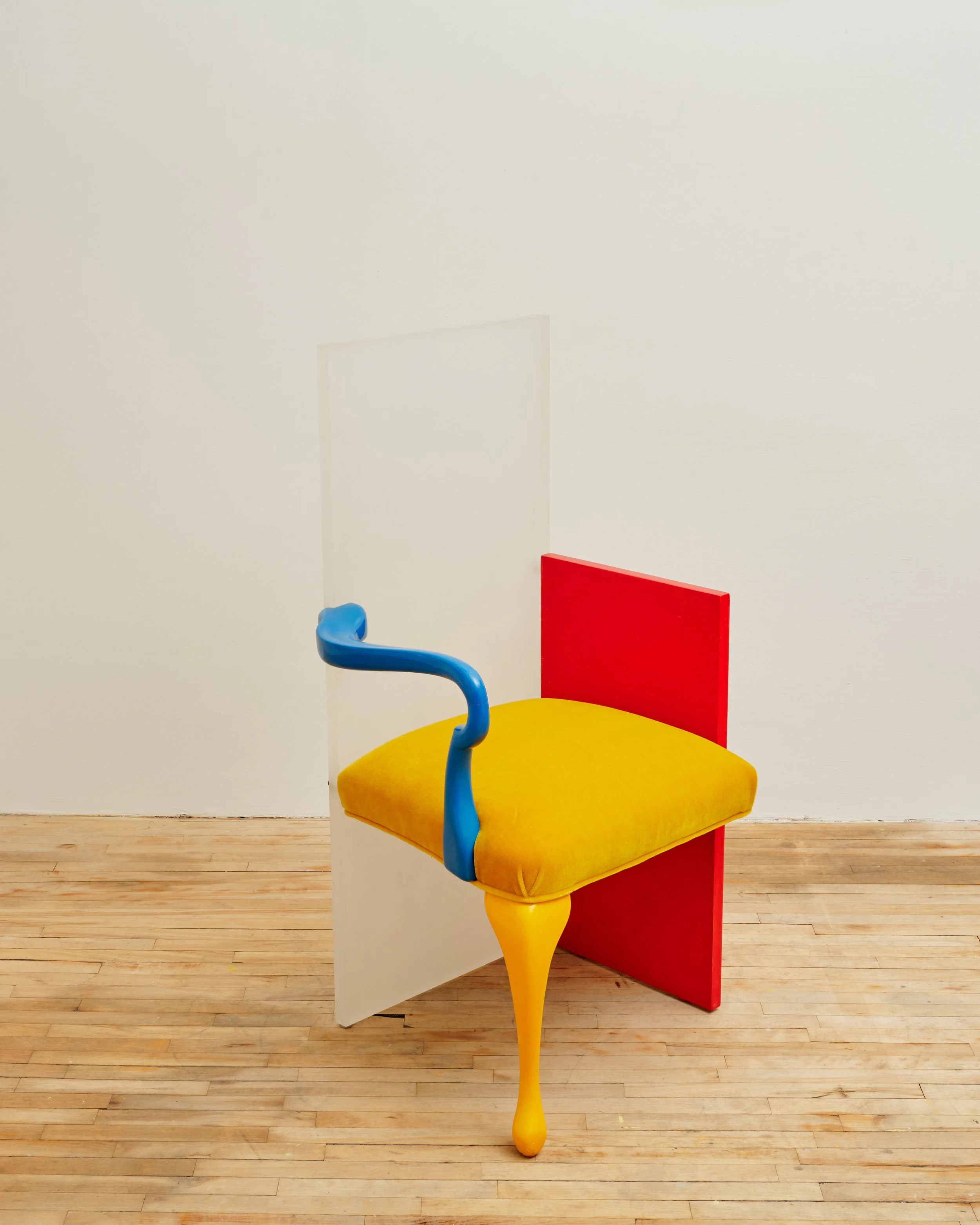
MondriAnne Chair (1982) by Main + Main.
Photo credit: Matthew Gordon.
Courtesy of Superhouse and Main + Main.
Thomas Mellins: You were trained as an architect. And I'm wondering how you think that informed your vision, and why you were drawn to these particular artists?
I was (interested in) form. . . .To be clear, not all the designs that I knew about and wrote about were things that I really appreciated, but I was interested in the creative process, and that was very important. I think that design evolves, and in the conversations with some of the people I interviewed, they said maybe (each design movement) has its period. If you look at Art Nouveau, it was popular for a period of time. Art Deco moved in and took its place, and then the Machine Age. International style evolved. So, when they were reflecting on their careers, these artists were saying, "Okay, I had this period of time that was my career." When I went to architecture school, we were imbued with the international style, with the work of modernists like Le Corbusier. So it certainly was revolutionary to start looking at work by Terence Main, Richard Snyder, Rosanne Somerson, or Wendy Maruyama. I was able to look at that (new style), embrace it, and say this has value. . . They wanted to move away from Knoll and Herman Miller. They said, "That's over. That is not for us.” Now, don't forget, they were moving to New York as Young Turks. They wanted to change the world.
I'm intrigued by the idea that it was an uphill climb, that it was difficult to find a market. If I think about the artists in Soho, I can see how it was difficult to sell paintings or sculptures. . .I would have thought intuitively that it would be easier to sell furniture. So I'm intrigued by the fact that an audience for this furniture needed to be developed. I’m struck by the idea that it sold more in New York when it became more expensive. Why do you think that was true?
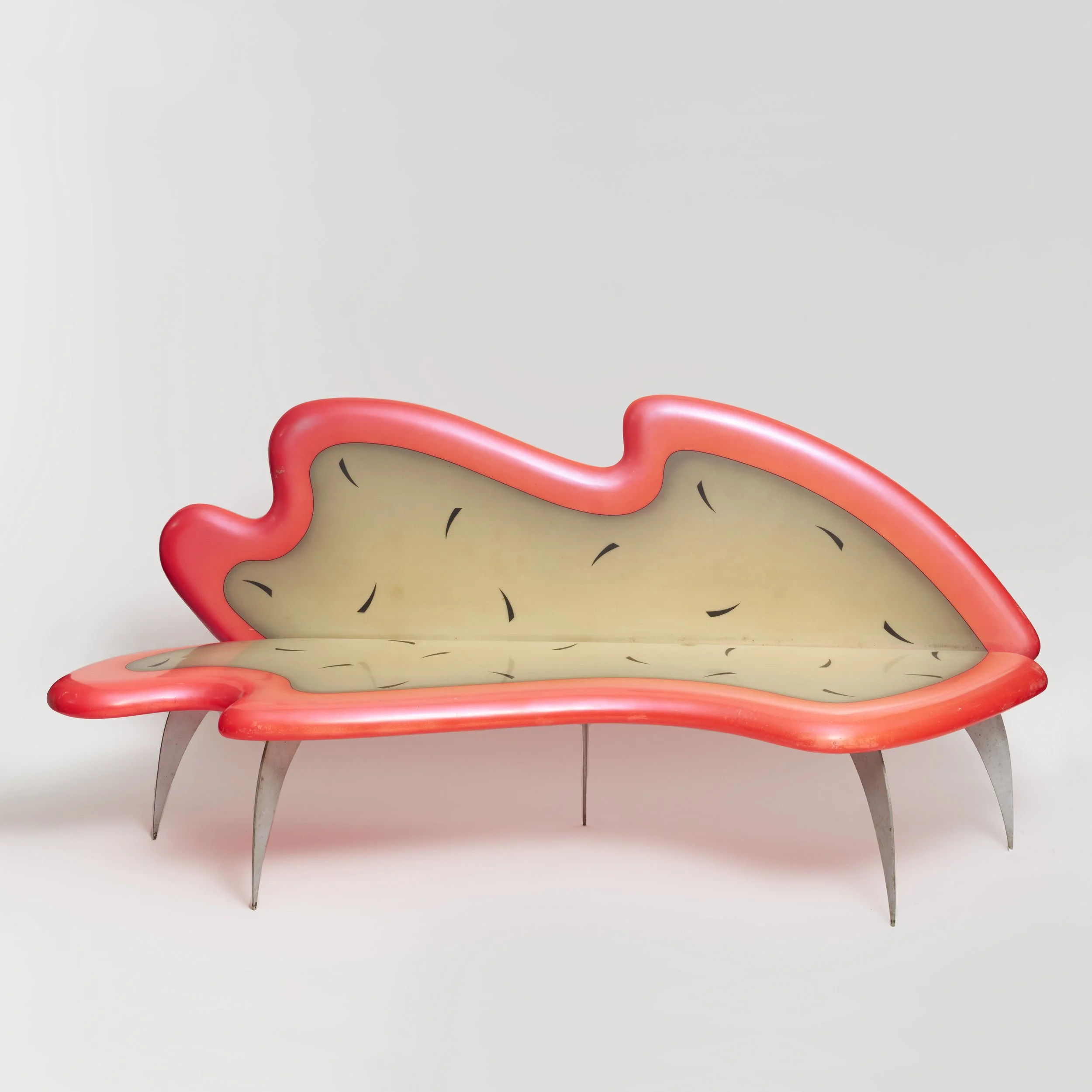
Gloria (1985) by Elizabeth Browning Jackson.
Courtesy of Abbeville Press, Superhouse, and Elizabeth Browning Jackson.
If we take a piece like this sofa behind me (Gloria (1985) by Elizabeth Browning Jackson), we must ask: is it comfortable? Is it going to go with the rest of your furniture? I mean, think about the buyer. Who is the buyer? The buyer is someone who thinks out of the box, who thinks: this is kind of wacky. I love it, and I can make my world work with this. And on the other hand, you had studio furniture makers who were making things shown in galleries like a Peter Joseph Gallery or Pritam and Eames. A buyer would have to appreciate what this artist put into the piece: the color of this wood, the way this wood is joined, the way the form of this piece stands for something. A lot of buyers of studio furniture would purchase many pieces in their homes and make a collection. Whereas I think if you see an (art furniture) piece like the (Gloria) couch or some of the other ones that we've seen, you have to wonder how many of these are you going to put in your house? They become real statements. We're talking about the 80s, 90s. Maybe people weren't so adventuresome; they didn't want to go out on a limb.
We have been struck by the very strong response to your book and to the exhibition, particularly among young people . . .Why do you think it is striking such a chord now, and how is it relevant to our time?
People are always interested in the past. There are always revivals. We've seen a revival in fashion from the '90s lately. We've seen music from the '80s and '90s. So you have a new generation of people who really didn't grow up with that. They didn't know much about that, and they look back at it and say, "Wow, this is amazing." And I think that's one of the reasons why we're seeing this, but I think there are advertising and commercial forces that are also influencing us to look back at past times, and maybe this is the time (for an art furniture revival). We're 30 years into it. It's not so unusual because, as I mentioned, there were revivals of appreciation of Art Deco furniture at a time. Now, you don't want it. Think of Biedermeier furniture that became popular. You couldn't buy it; it was so expensive, and now you can't get rid of it. So things go through cycles, and I'm glad that this (movement) is in our consciousness, and people are appreciating it.
Watch Dennis Miller’s full book talk, Art + Furniture, HERE.