
The Winner of the 2025 Ferguson & Shamamian Travel Award at NYSID Studied 300-Year-Old Ottoman Eco-Mansions

Principal Joseph Zvejnicks, Michelle Obayda, Julia Kim, and Partner Stephen T. Chrisman
Julia Kim (MFA1) was the 2025 winner of the Ferguson & Shamamian Travel Award for Cultural Discovery at NYSID, a $5,000 prize. The award enabled her to study iconic Ottoman architecture in Istanbul, before exploring the mansions of Safranbolu, known for traditional Turkish design that offers lessons for contemporary sustainable practice. The F&S award, created specifically for a NYSID interior design student, culminates in a year-long, paid internship at Ferguson & Shamamian Architects. Kim traveled to Türkiye (formerly known as Turkey) from August 18 to 29, 2025, spending time in Istanbul’s Sultanahmet and Beyoğlu districts and in Safranbolu, with stopovers in Amsterdam and Delft in the Netherlands. She began her internship at Ferguson & Shamamian in September 2025.
“Education is of critical importance to us at Ferguson & Shamamian,” says Stephen Chrisman, a partner at Ferguson & Shamamian Architects. “The opportunity to create an internship with the New York School of Interior Design was exciting because collaborating with interior designers is a critical component of our work as architects, and the idea that students could create a program that they wanted to study and bring what they learned from their travels into practice in our office was very interesting to us.” Kim will present her independent study at a Ferguson & Shamamian staff meeting this year, giving her the opportunity to consolidate her knowledge and share it with the entire firm.
Kim discusses her travels in Türkiye with Jennifer Dorr, NYSID’s managing editor, here.
Jennifer Dorr: Why did you choose to make the Ottoman houses of Safranbolu the center of your independent study?
Julia Kim: Safranbolu, in Türkiye's northern Karabük province, is one of the best-preserved Ottoman towns in existence. Recognized as a UNESCO World Heritage Site since 1994, this historic settlement flourished as a hub on the east-west caravan trade routes for centuries. The Ottoman mansions of Safranbolu are 200 to 300 years old. A lot of people are restoring them, and the best known among them is the architect Fatih Dökmeci. They're very interesting because Türkiye gets really hot in the summer, yet up in the mountains by the Black Sea, it also gets very cold in the winter, and these mansions stay naturally cool in the summer and comfortable in the winter. Local people have been restoring them and choosing to live in them, and I was captivated by this. It's wonderful when people choose to preserve their culture and history instead of building something new. It's important that we learn from vernacular architecture, which often is suited to the climate and geography of a region. Anything we can learn to reduce our electricity use and carbon footprint is of interest to me.
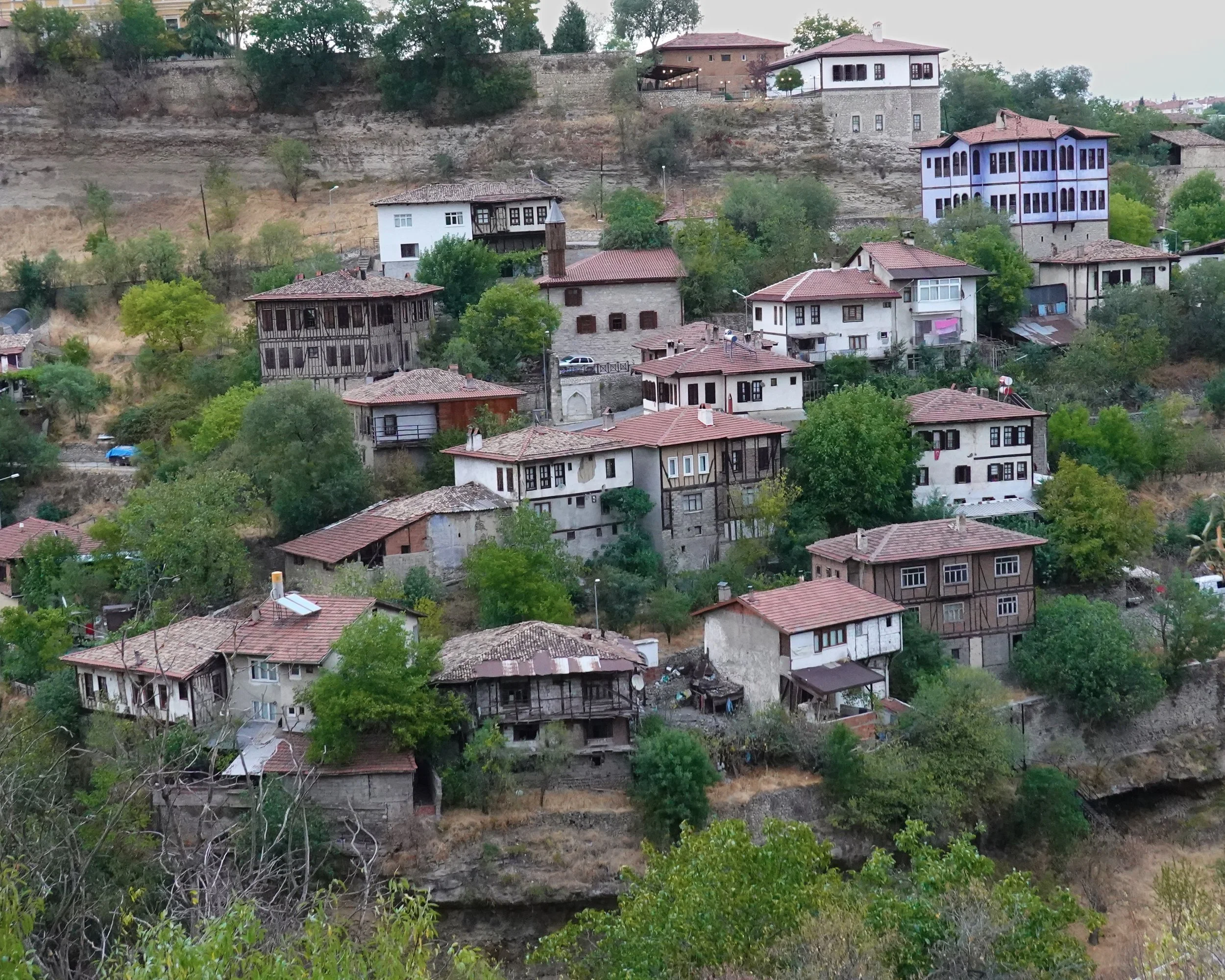
Safranbolu, Türkiye
Did you study Turkish design with an institute or structured class, or was your research entirely self directed?
This opportunity has been one of the highlights of my NYSID education, and I have had many wonderful moments and an all-around incredible experience at this college. What set this apart was the fact that I could direct my own research. I didn’t take a formal course, but I learned from many knowledgeable people. I began in Sultanahmet, the district of Istanbul where one can see the Hagia Sophia, The Blue Mosque, the Basilica Cistern, and more. In Istanbul, I took walking tours with a Fulbright scholar named Haktan Tursun, who helped me begin to understand Turkish history and culture.
Then, I took a more than eight-hour bus ride, through the mountains, to the town of Safranbolu. I stayed in one of the city’s traditional mansions, called a konak, which had been restored and converted into a hotel called Çamlıca Konağı by the owner Özlem Özen and the architect Fatih Dökmeci. I was able to interview the owner of the konak, and she introduced me to her friend Cengiz, the owner of Tabağ Ahmet Bey Konağı, an unrestored konak. He’s from a Safranbolu leather manufacturing family, and generously took me on a tour of his 200-year-old, unrestored konak. He spent hours, using Google Translate, to tell me about the history of the home and answer my questions. When I thanked him for his time and for sharing his knowledge with me, he replied, “Knowledge grows when shared.” When I got home and started my internship, it struck me that this is the ethos I feel when I am at Ferguson & Shamamian. The idea comes from the Turkish proverb: "Bilgi, paylaştıkça çoğalan bir hazinedir." It means “Knowledge is a treasure that grows with sharing.”
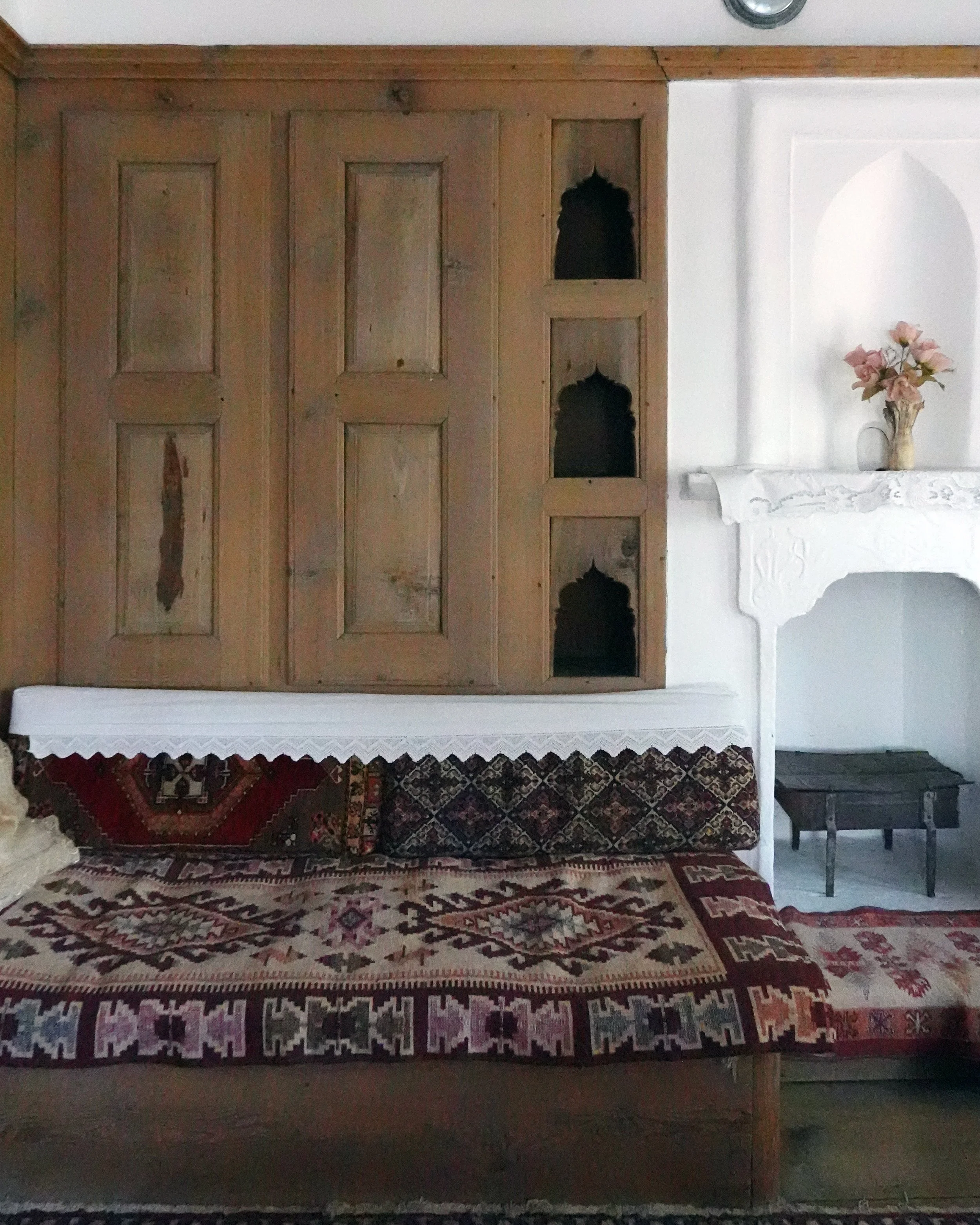
Tabağ Ahmet Bey Konağı interior in Safranbolu, Türkiye
What did you learn about sustainable design practices from staying in, and closely observing, 300-year-old konaks?
I wanted to test the idea that air conditioning was not needed in these structures during the summer months by measuring the airflow in the interior at different times of day, but unfortunately my monitor failed me. Nonetheless, when I woke up each morning and went downstairs, I could touch the stone. The first floor has a lot of stone walls, and I could feel that it was cool in the interior. And then in the middle of the day, when I might be coming back to take a quick rest, I could feel that the stone walls were still cold in the hottest part of the day. It's the materials that help the buildings regulate temperature on their own. The owner of the konak I stayed at told me it was a traditional combination of wood, stone, and special mortar that keeps the buildings cool and makes them so durable. When I was at the leather tannery museum (Tabakhane Museum), I learned that one of the ingredients in the mortar is actually a byproduct from the leather tanning industry. Now they use modern methods, so it's not done in the same way, but historically they used waste from tanning in the mortar, and that made the walls better able to regulate temperature.
The design of the konaks is precisely attuned to the geography and climate of the place, which is a lesson in the way all designers should approach buildings. The konaks are all oriented in a specific way in relation to the sun and wind. The bay windows on the third floors of the konaks are important: they stick out a little bit, and can catch the mountain breeze on the upper floors. I also learned that the bay windows can help bring in natural light further into the interior.
Staying there, I was also able to realize the importance of the gardens. Every day for breakfast, we would be served Turkish breakfast, and a lot of the produce actually came from the on-site gardens, which still play an important day-to-day role in the lives of the people who live there. I think one interesting thing that I can apply to my practice is proximity to the garden. I think we, as designers, sometimes forget how we can influence people's behavior in a positive way. Having room for a garden can help someone be healthier.
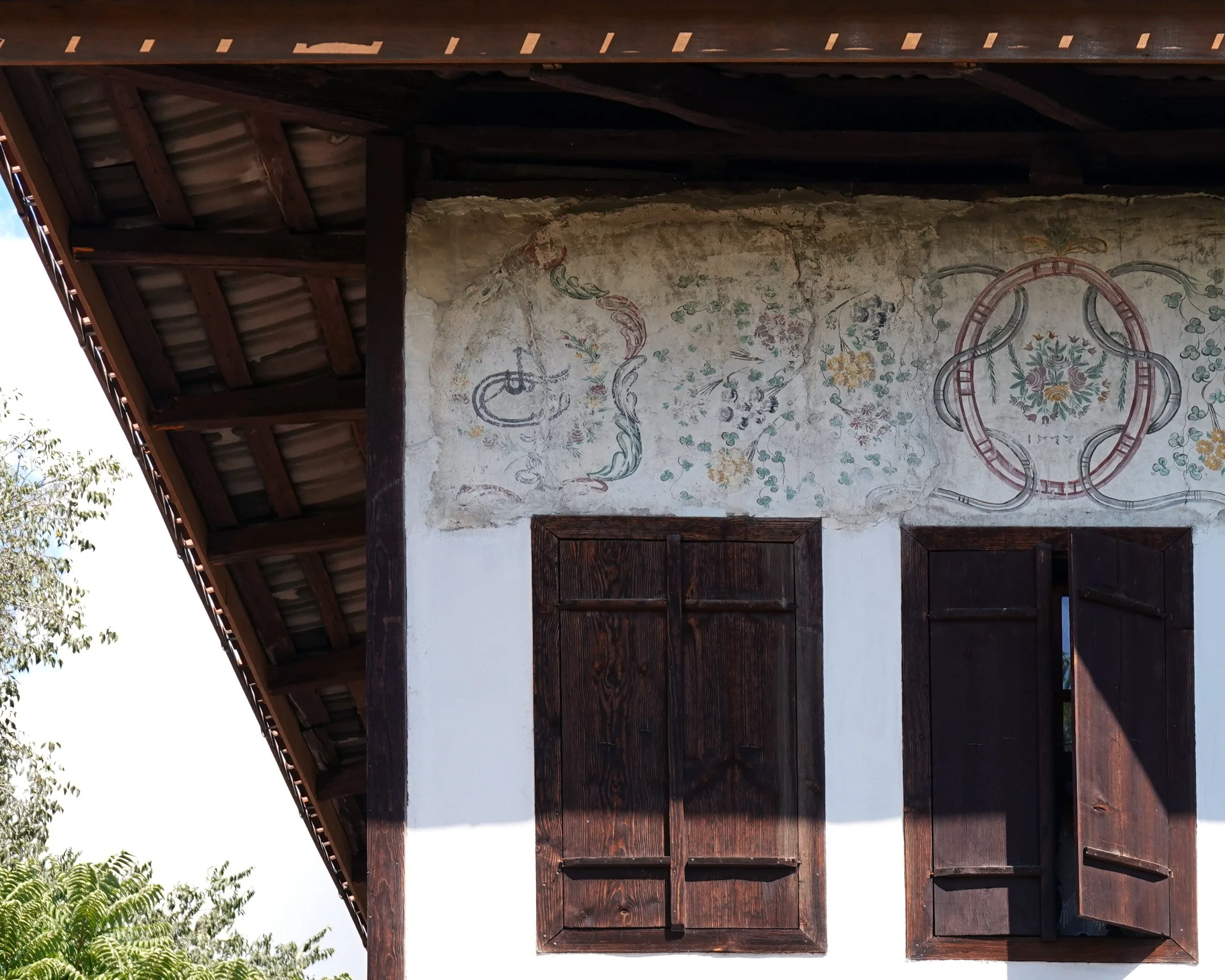
Konak detail on a building in Safranbolu, Türkiye
What other aspects of your study in Türkiye will influence your work?
There was much to learn about designing for privacy in traditional Ottoman residences. The part of the home that was considered private, for the women, was the harem. This was hidden from the public quarters, the selamlik, where men from outside the family would visit. The bigger homes even had separate entrances and separate stairways for men and women. The cumbas, the bay windows that jutted out, had beautiful screens so that women could get fresh air and see outside without being viewed by the public. Sometimes as a designer you need to create privacy, and I think these are interesting techniques to emulate. One of the most interesting things I saw was a door screen, fashioned such that the door almost had its own very small vestibule, and it was angled in a way so that when you opened the door, you wouldn’t necessarily be able to see who was in the room from the hallway. It’s a technique that might be nice for a bathroom entrance, or whenever you want to create privacy.
I was drawn to some of the ceilings in particular. Those ceilings were actually a way to be a good host. In Ottoman culture, which reveres hospitality, the most important rooms in the home were reserved for guests, and they had the most intricately carved ceilings. Also in Safranbolu, every home has the work of the blacksmiths, from the doorknockers to the hinges on the windows, and this rustic metalwork made an impression on me. All of these sights will influence my work.
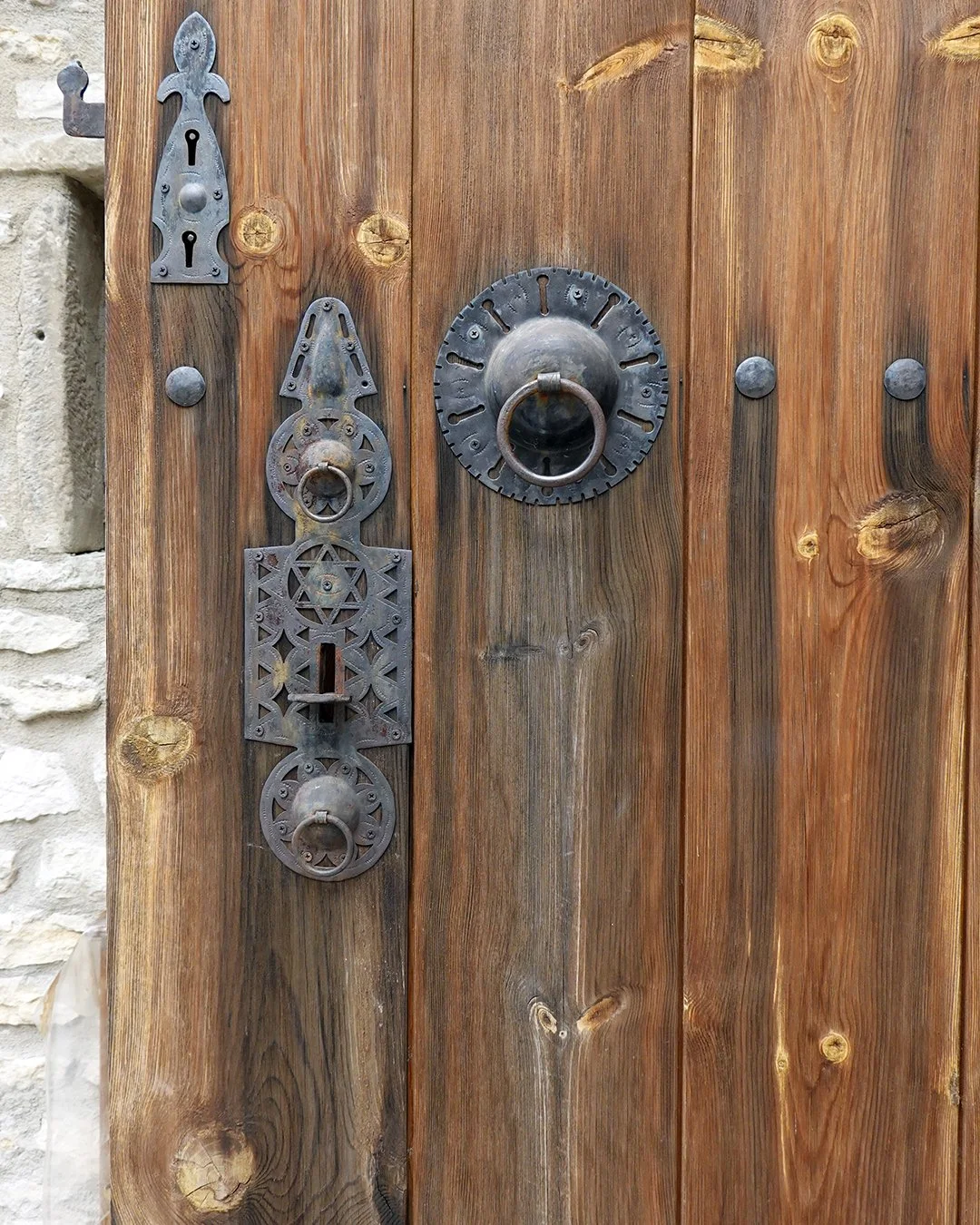
Door detail featuring the craftsmanship of a local metalsmith in Safranbolu, Türkiye
We know you have just begun, but will you tell us about your internship at Ferguson & Shamamian Architects?
The internship is once a week for a year. They will be cycling me through different departments throughout the course of the year. I'm beginning my internship with the rendering department, working for Principal Joey Zvejnieks and his team. The assignment I’m starting off with first is to create a suite of neutral furniture and accessory models suitable for early design-stage renderings, offering a sense of scale without defining style, while aligning with the firm’s overall traditional aesthetic. This is something they can use to give the room context before the interior designer has selected furniture. The members of the rendering team, Michelle and Brendan, have taken the time to teach me what makes a good model and helped me understand the design aesthetic of Ferguson & Shamamian, which is very traditional. It's definitely a learning environment. Once a month on Wednesday, the team has a library book club, where one of the architects presents a book on traditional or classical design. The firm promotes a collegial environment where knowledge is shared. Once a month, they have a sketching group, and this month they are going to sketch at the Frick. The whole experience is such an incredible opportunity, and I'm grateful for it.
Interested in Partnering with the New York School of Interior Design?
The New York School of Interior Design partners with sponsors to create customized scholarships, internships, awards, and learning opportunities that spark innovation or help NYSID students use design to address real world problems. To discuss creating and naming a scholarship or award, please reach out to Joy Cooper, Director of Development, at giving@nysid.edu. Together, we can harness the power of design to improve lives and build a better future.