
2025 Robert Herring Travel Prize Winner, Hadley Jones, Shares Her Journey
At Commencement 2025, NYSID's Office of Academic Affairs awarded Hadley Jones ‘25 (MFA1) the Robert Herring Travel Prize.
The prize recognizes exceptional design and presentation skills and must be used within 10 months following graduation, for a program of travel proposed by the recipient. The award is named in memory of beloved NYSID instructor Robert Herring, who was an advocate for the importance of travel in the development of young designers. Every Herring Prize winner writes a first-person account of their journey.
Hadley, who is now a junior designer at Champalimaud Design, traveled for 17 days in Singapore and Thailand. Here is Hadley’s essay about how her journey through iconic cities and historic landmarks will influence her design work.
Reflections on a Incredible Journey: The 2026 Robert Herring Travel Prize Experience
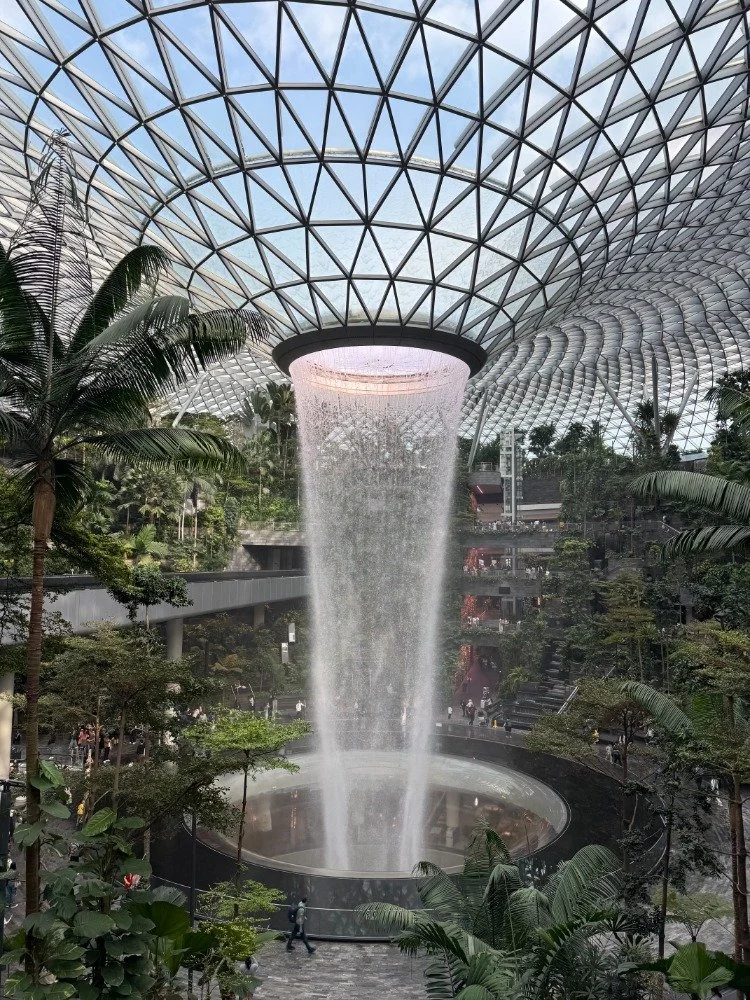
The Changi Jewel
On January 14, 2026, after months of planning and anticipation, I embarked on a journey to Southeast Asia that profoundly shaped my perspective as both a designer and a traveler. Carrying only a backpack and a small suitcase, I headed to the airport to board the world’s longest nonstop commercial flight to Singapore. While I anticipated that the trip would expose me to new cultures, architecture, and landscapes, I didn’t foresee just how much it would change my understanding of hospitality, biophilic design, and the relationship between tradition and modernity in the built environment. Over the course of seventeen days across Singapore and Thailand, I encountered spaces that challenged my assumptions about architecture and interior design while reinforcing the emotional impact that thoughtfully designed environments have on the human experience.
My first introduction to Southeast Asia was Singapore’s Changi International Airport, which immediately redefined what I believed an airport could be. Rather than functioning solely as a place of transit, Changi felt like a destination. The airport’s Jewel complex was especially impactful. The world class shopping mall is structured around a dramatic indoor rainforest with a 130-foot Rain Vortex waterfall at its core, seamlessly blending architecture, nature, retail, and dining into one immersive environment. The soaring glass dome floods the interior with natural light while lush vegetation softens the steel and concrete structure. During my time at NYSID, I studied biophilic design but experiencing it firsthand at this monumental scale was entirely different. The Changi Jewel did not merely include nature as decoration; nature became the centerpiece around which the entire experience revolved.
After a good night’s rest at Changi’s Crowne Plaza Hotel, I woke up early to explore additional airside attractions before catching a midday flight to Bangkok. My favorite of these was Dreamscape, an immersive installation that combined digital media with living plants to create a surreal sensory escape. Like the Jewel, this installation boasted Singapore’s mastery of biophilic design. As I stood beneath animated projections of ponds, lily pads, fish, and drifting rowboats, I considered how powerful storytelling can transform a space. Dreamscape’s use of lighting, motion, sound, and scale created a childlike sense of wonder that drew me in, making me briefly forget that I was in the middle of a busy terminal.
In Bangkok, I encountered an entirely different architectural language rooted in tradition, spirituality, and craftsmanship. My home for the next few days was Loy La Long, a small teakwood guesthouse floating on the Chao Phraya River in Chinatown. Unlike the grand spectacle of Changi, Loy La Long’s quaint and whimsical accommodation offered intimacy and authenticity. The creaking wooden floors, sounds of the river gently flowing beneath the building, and handmade details created an atmosphere that felt deeply personal, like I was staying at a friend’s home. After busy days exploring the bustling city, I loved coming back to such a peaceful retreat.
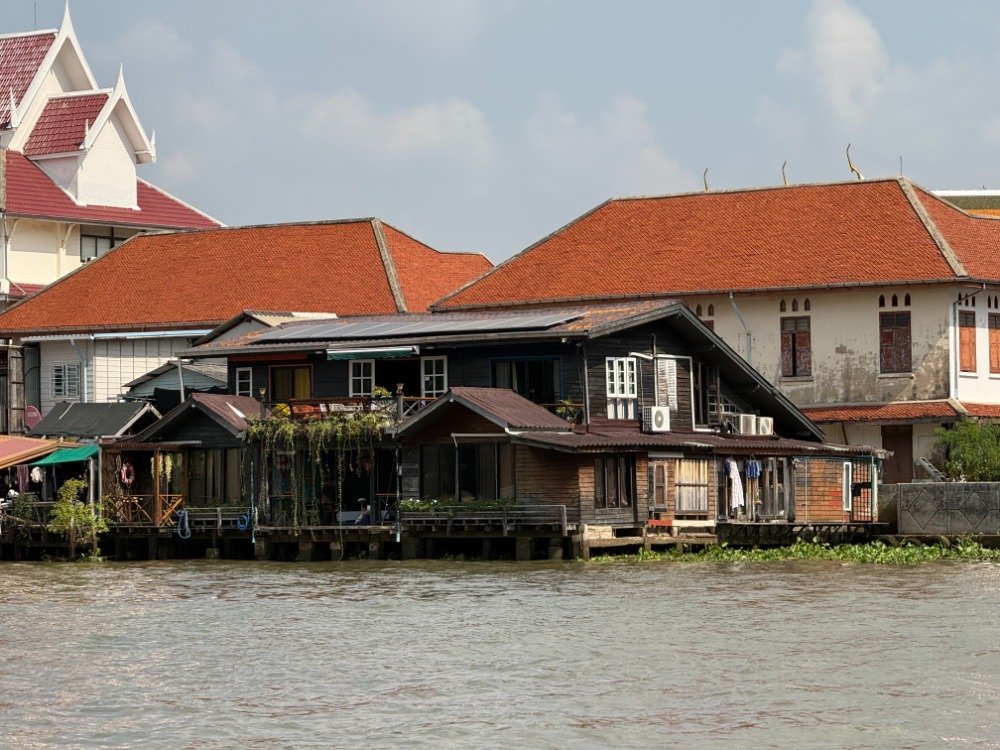
Loy La Long Hotel
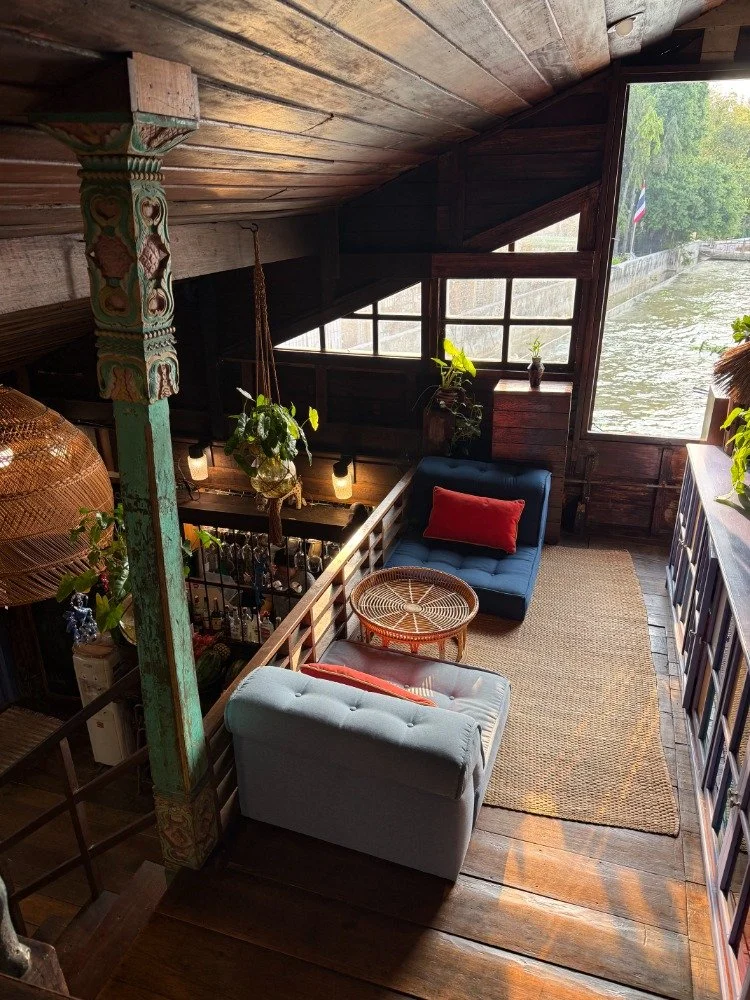
Loy La Long Hotel
During my time in Bangkok, I explored several of Thailand’s most significant Buddhist temple complexes, including Wat Pho, Wat Arun, and the Grand Palace. Visiting these spaces was transformative because they challenged my Western assumptions about religious architecture and spatial organization. Rather than centering worship within a single monumental structure, the temple complexes unfolded through a series of buildings, courtyards, gardens, and shrines. At Wat Pho, I spent hours wandering through seemingly endless layered spaces filled with orchids, reflecting pools, colorful mosaics, and gilded ornamentation. Through this experience, I understood that the emphasis on rhythm and sequence encourages mindfulness and contemplation, two core principles of Buddhist teachings.
Wat Arun particularly fascinated me because of its intricate use of recycled materials. More of a towering monument than an extensive temple complex like Wat Pho, Wat Arun was just as impressive. From afar the temple appeared dark against the skyline, but closer inspection revealed elaborate mosaics composed of broken ceramics, porcelain, seashells, and colored tiles. Seeing ordinary discarded materials transformed into one of Thailand’s most iconic landmarks deeply resonated with me as a designer. It demonstrated the beauty of adaptive reuse and sustainable design, proving that expensive materials are not always needed to create something extraordinary.
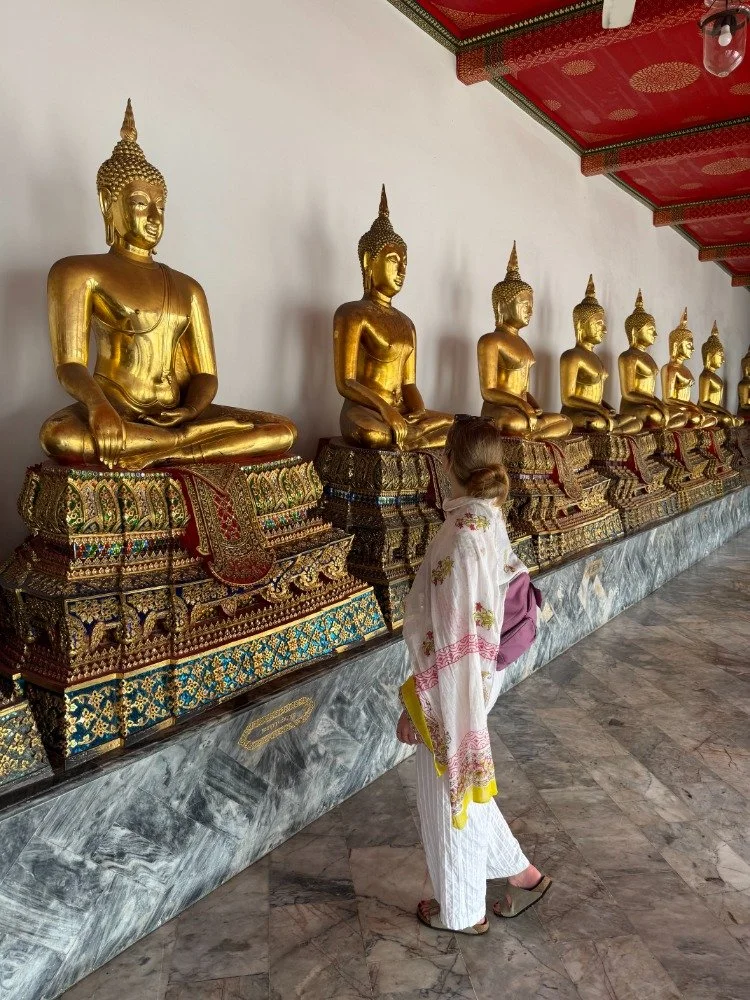
Hadley Jones ‘25 (MFA1) at Wat Pho temple
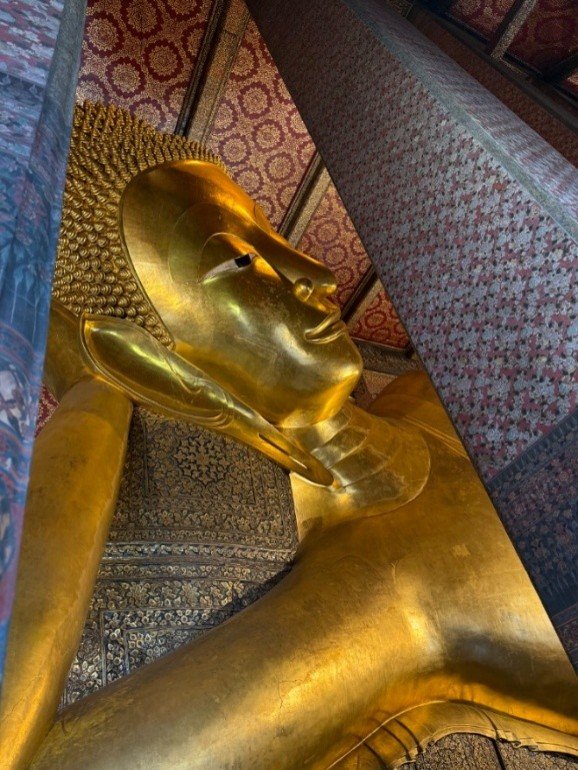
Reclining Buddha at Wat Pho temple
One of the highlights of my time in Bangkok was visiting the Jim Thompson House. Built in 1959, the home was constructed from six traditional Thai teakwood structures that were relocated and reassembled together. The house embodies a harmonious fusion of Thai vernacular architecture and Western influence, namely the dining room with a table and chairs. The thoughtful open-air layout, integration of gardens, and handcrafted detailing created an urban oasis within the city. I found the guided tour fascinating, especially learning more about Jim’s life and the unsolved mystery surrounding his 1967 disappearance.
While in Bangkok, I was intrigued by the coexistence of historic tradition with hyper-modern development. Nowhere was this more evident than Icon Siam, the city’s enormous luxury shopping complex. In contrast to many struggling malls in the United States, the Icon Siam was buzzing with activity. At first, I wondered why this was the case. Aside from indoor malls being a popular way for locals to escape the intense heat, I quickly discovered that Icon’s concept goes far beyond retail. The space incorporates art installations, experiential attractions, and public gathering spaces that transform routine shopping into entertainment. This observation led me to reflect on the future of large-scale retail design and how success depends on creating experiences that can’t be replicated online.
Throughout my travels in Thailand, I became increasingly aware of how differently Singapore and Thailand approached biophilic design. Singapore often emphasized futuristic integration between nature and technology, whereas Thailand’s approach felt more restrained and rooted in tradition. This distinction became especially apparent during my visit to the spa at the Mandarin Oriental Bangkok. Located within a restored teakwood house across the river from the main hotel, the spa grounds incorporated reflection pools, lotus flowers, tropical gardens, and natural materials to create a serene and meditative environment. Instead of creating spectacle, the design relied on balance and thoughtful use of materials to help ground and relax guests before having their treatments. Experiencing Thailand’s renowned hospitality firsthand reaffirmed how the thoughtful integration of nature, architecture, and exceptional service can shape our emotional and physical well-being.
On my last day in the Bangkok area, I planned a day trip to visit Ayutthaya, the ancient capital of Siam and UNESCO World Heritage Site that rests just over an hour outside of the city. Ayutthaya’s ruins are spread out on an island surrounded by three rivers and integrated within a modern community that still inhabits the area today. Exploring the site showed me how deeply modern Thai temple design remains connected to ancient traditions. Like Wat Pho, the temple complexes were sprawling and organized around a series of structures, courtyards, and ceremonial spaces. Repetition of the Buddha figure along pathways and at altars also reminded me of the more modern temples I had already visited in Bangkok. I loved learning about the history of Ayutthaya and imagining what the place would have looked like before its destruction by the Burmese in 1767.
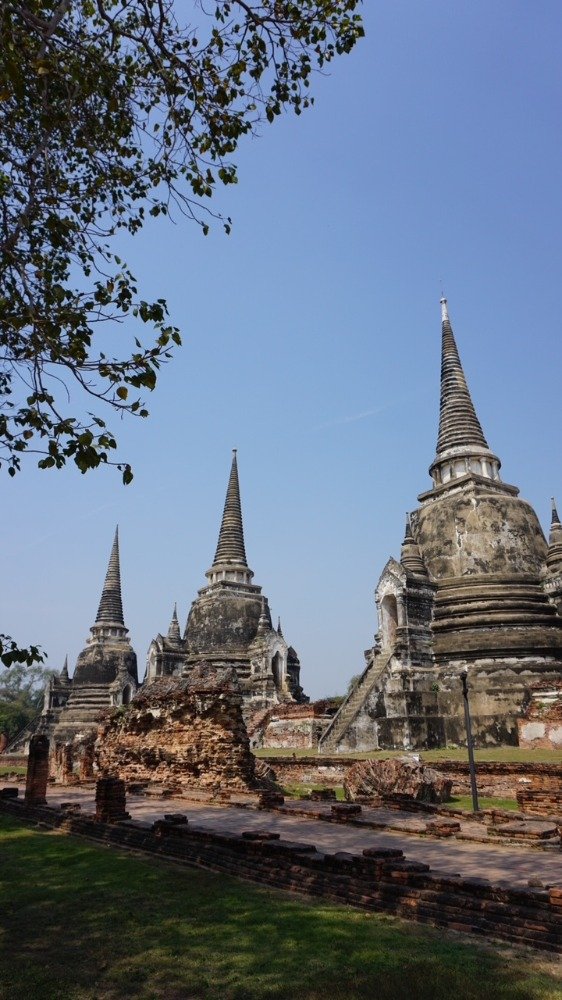
Three Chedis of Wat Phra Si Sanphet in Ayutthaya
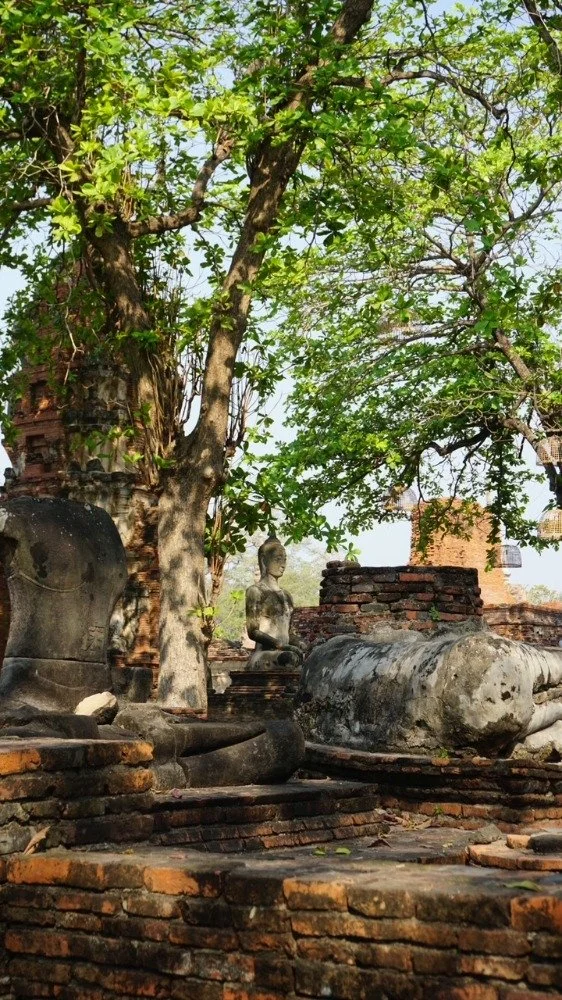
Wat Mahathat temple in Ayutthaya
After several days in the Bangkok area, I traveled north to Chiang Mai, where the atmosphere shifted dramatically. Compared to Bangkok’s intensity, Chiang Mai felt slower, quieter, and even more connected to nature. I stayed at Tamarind Village, a boutique hotel known for its traditional Lanna architecture, which is characterized by teakwood construction, layered roofs, and carved ornamentation. The modest elegance of Northern Thai design made it one of my favorites as it prioritized craftsmanship, felt homey and comfortable, and existed in harmony with the surrounding environment.
In Chiang Mai, I explored smaller Buddhist temples, local markets, and cultural sites while also indulging in experiences such as a Thai cooking class and visiting Elephant Nature Park. One of my most memorable experiences was hiking the Monks Trail to Doi Suthep Temple. After climbing steep forest paths and ascending a long staircase flanked by dragon sculptures, I reached the mountaintop temple overlooking the city below. Unlike the colorful mosaic-covered temples of Bangkok, Doi Suthep favored heavily gilded surfaces that contrasted natural wood and whitewashed structures. The temple felt more intimate and spiritually grounded, with many practicing monks monitoring the grounds and shrines.
I concluded my journey by returning to Singapore for a few final days before flying home. After spending so much time in Thailand exploring historic sites, being back in futuristic Singapore was a striking juxtaposition. This time, I stayed at the PARKROYAL COLLECTION, a hotel internationally recognized for its sustainable and biophilic architecture. The building itself resembles a vertical garden, with cascading greenery integrated into terraces and facades. My stay at the PARKROYAL was yet another example of Singapore’s emphasis on the integration of nature, sustainability, and large-scale architectural development.
While in Singapore, I visited Kampong Glam, the National Gallery, the historic Raffles Hotel, Gardens by the Bay, and dined at various hawker markets. Gardens by the Bay was very significant because it represented the culmination of Singapore’s vision for the future of urban design. The Cloud Forest and Supertree Grove combined environmental engineering with theatrical storytelling to create spaces that educated visitors while inspiring awe. Walking through elevated pathways surrounded by mist, waterfalls, and rare plant species, I appreciated how immersive environments can shape public engagement with sustainability and conservation.
On my last night of the trip, I visited the Marina Bay Sands rooftop observation deck and enjoyed a classic Singapore Sling while observing panoramic views of the sunset. Reflecting on my adventure, I recognized how transformative this trip was for my growth as a designer. Traveling through Singapore and Thailand exposed me to entirely different approaches to architecture, hospitality, urbanism, and cultural preservation. I observed how spaces can foster community, spirituality, wonder, relaxation, and connection to nature. Good design has never been solely about aesthetics. The most memorable spaces I encountered succeeded because they told stories, honored cultural identity, and created emotional resonance.
Receiving the Robert Herring Travel Prize made this experience possible, and I am profoundly grateful for the opportunity. This trip expanded not only my understanding of design, but also my confidence, curiosity, and perspective on the world. I think one of the most inspirational things I learned about Thai design is their willingness to upcycle materials to create decorative ornament. Above all, I loved experiencing Thailand’s relaxed culture and genuine kindness of the people there. On the other hand, Singapore was futuristic and exciting as it is leading the way in cutting-edge biophilic design and embracing new technology. The lessons I gained from Southeast Asia will forever influence my work and design philosophy, and I now look back fondly as I embark on my career in New York City.