
NYSID’s Service Learning Studio Designs a Center that Will Help Older Adults Thrive
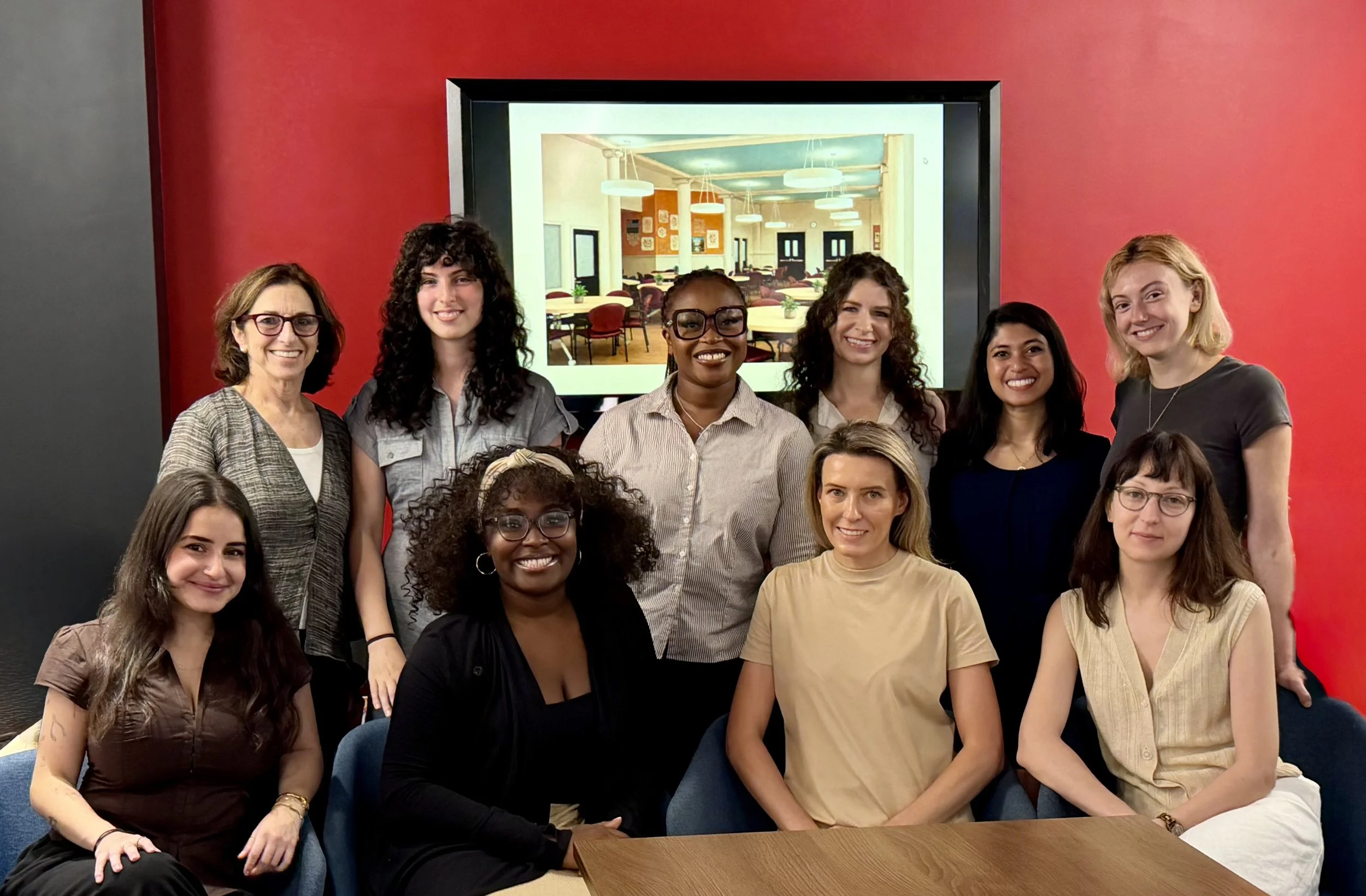
Faculty member Terry Kleinberg; Students Sofia Ditullio (MFA1), Akalah Bobb (MFA1), Lauren Seidenberg (MFA1), Uzma Nur (MFA1), Isabella DiMaggio (MFA1), Stefanie T (MFA1), Carmen Graham (MFA1), Ruta Kraujutyte (MFA1), and Inna Yatskiv (MFA1)
This summer 2026, NYSID’s Summer Service Learning Studio designed a center for Encore Community Services in Manhattan, a non-profit that defines its mission as “providing care and service to older adults...assisting those who are vulnerable, frail, poor and homeless, homebound and lonely, frequently desperate, most often ignored; helping them with their daily needs so that they might live as independently as possible.”
NYSID’s unique Summer Service Learning Studio allows its professional-level Master of Fine Arts in Interior Design (MFA1) students to participate in social impact design for non-profit clients with real budgets, constraints, and parameters. In this studio, designs are not theoretical—some are eventually adapted and built—and students lead the design process instead of assisting at a junior level as one might do in an internship. The popular course has been led by faculty member Terry Kleinberg, RA, since 2016. Says Uzma Nur (MFA1), who worked on this project, “The biggest difference between service learning and a traditional studio is getting to experience collaborating in a group rather than designing independently. Everyone brought different strengths and perspectives, which gave me a better sense of what working on a project in a real design firm could be like.”
Encore Community Services asked the 2026 Service Learning team to design both public and staff spaces for a large, multipurpose community center for older adults. This open basement space beneath a church, as it exists now, is challenging because there is no natural light, distracting noise, terrible acoustics, and no privacy. The organization is moving most of their giant kitchen offsite and was looking for ways to repurpose this space. In this community center, caseworkers need to provide counseling; volunteers pack and serve more than 2,500 meals a day; community members come together to dine, engage in programmed activities, and socialize; and staff and leadership must accomplish the planning and organization that makes these vital services possible. Says Kleinberg, “The project was close to the Graduate Center, which means the students were able to visit often and observe the way the space was used. What really impressed me was how much of their invention came from observation.” Says Nur, “My biggest takeaway was the importance of understanding how an organization actually operates before making design decisions...Good design isn't just about creating a beautiful space; it has to work for the people who use it.”
Students Akalah Bobb (MFA1), Sofia Ditullio (MFA1), Carmen Graham (MFA1), and Stefanie T (MFA1) designed the public and community spaces. Among their accomplishments were defining clear activity zones; promoting social connection; maximizing seating capacity; specifying durable, senior-friendly furnishings; choosing colors that are easier for those with vision loss to perceive; and creating a safe, uncluttered, calming, and welcoming environment. Kleinberg was particularly impressed by the reception area design, which introduced a clear brand identity into the space, and the walk-in closet and retail environment, which were created because students noticed that many donations coming to the center were stored in bags. The team designated space for a beautiful store, designed like a walk-in closet where visitors could shop and try on clothes with dignity, stripping away the stigma that’s often associated with taking second-hand clothing donations.
Encore public and community spaces designed by Akalah Bobb (MFA1), Sofia Ditullio (MFA1), Carmen Graham (MFA1), and Stefanie T (MFA1)
Isabella DiMaggio (MFA1), Ruta Kraujutyte (MFA1), Uzma Nur (MFA1), Lauren Seidenberg (MFA1), and Inna Yatskiv (MFA1) designed the staff spaces. Their accomplishments included increasing privacy through intentional space planning, optimizing furniture layout and employing vertical storage to maximize space, tastefully camouflaging existing infrastructure, improving acoustics in staff spaces, adding warm, controllable lighting, and reimagining the breakroom as a welcoming retreat. The team hid exposed pipes by dropping the ceiling in the staff breakroom, creating a cozy nook, and transforming a problem into an asset. Says Kleinberg, “Nonprofit jobs are stressful; people do them in challenging conditions, and those employees deserve attention. I think designing for staff was an eye-opener for our students...One of the staff members was tearing up at the presentation because she was so moved.”
Encore staff spaces designed by Isabella DiMaggio (MFA1), Ruta Kraujutyte (MFA1), Uzma Nur (MFA1), Lauren Seidenberg (MFA1), and Inna Yatskiv (MFA1)
Three students from NYSID’s Master of Professional Studies in Lighting Design (MPSL), Fiona Grunwald, Danny Pachman, and Robert Hill Guarino, served as consultants on the lighting of the space. Eric Cohen, a former NYSID faculty member and specialist in design for older adults, was a recurring guest critic and mentor to the team.
“It was rewarding to apply concepts such as programming, accessibility, material selection, acoustics, and space planning to a project that will have a meaningful impact,” says Akalah Bobb. “Seeing the client’s positive reaction to our final presentation was incredibly fulfilling because, as a team, we were able to address the needs they shared with us,” she adds. “Working with Encore was especially meaningful because of how vibrant and welcoming their community is.”
Encore Community Services Operations Director Genesis Tavarez reflects, “Throughout the process, I was impressed by how engaged and focused the students were in understanding our needs...We were genuinely impressed by how they brought our vision and ideas to life. They created a warm and welcoming environment that would help our older adults feel comfortable, safe, and at ease.” She adds, “Encore absolutely plans to use the designs and ideas as part of a future renovation. We are hoping to begin with the reception area as our first phase.”
Interested in the MFA1?
Research-based design that has a social impact is core to every NYSID degree. NYSID’s Service Learning Studio is a unique feature of its professional-level Master of Fine Arts in Interior Design (MFA1), and it fulfills the program’s summer experiential learning requirement. For information about the MFA1 or which academic program at NYSID is right for you, start HERE or reach out to admissions@nysid.edu.
Interested in Service Learning?
If you are a student already enrolled at NYSID with questions about service learning, please reach out to academicaffairs@nysid.edu.