
Transformative Travel Study in Japan
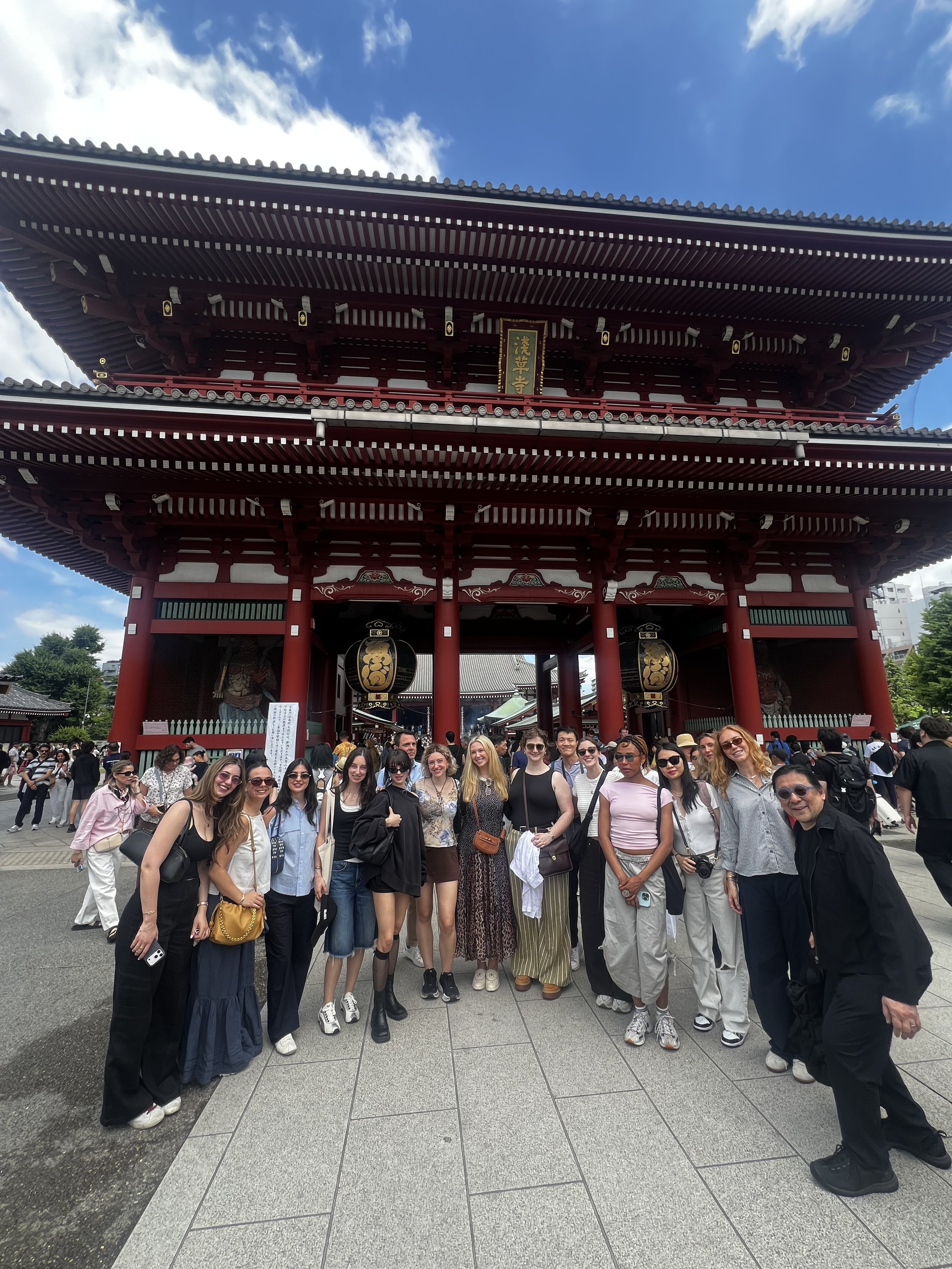
Jackie Kletter, Laney Rogers, Mia Blavatnik, Melissa Douer, La Kosematoglu, David Sprouls, Isabella DiMaggio, Sasha Sklarov, Tate Horstkotte, Peter Fisher, Julia-Kate Schamroth, Arielle Noterielle, Xinrou Qiu, Avery Bowers, Nicole Grabe, and instructor Yutaka Takiura at the Sensō-ji temple
From May 25 to June 3, 20 NYSID students traveled to Japan in conjunction with a course called Journey to Japan: Art & Design in the World of the Chrysanthemum Throne. The instructor of the design history course was Yutaka Takiura, an architect specializing in modern design who received a B.Arch. from Waseda University in Tokyo; a master’s degree in architecture from the Illinois Institute of Technology; and a second master’s degree in architecture in urban design from the University of Pennsylvania. The travel group included NYSID President David Sprouls and Academic Administrative Director Grace Lubell, who assisted the instructor with logistics for the large group. Lubell speaks Japanese and has a master’s degree in Japanese humanities with a focus on ancient Buddhist art.
Four students on the trip—Jeanne Bourgogne (MFA1), Peter Fisher (MFA1), Natalia Kamesh (BFA), and Lal Kosematoglu (MFA1)—along with Xinrou Qiu ‘26 (BFA), a student on an independent study, received a full or partial scholarship from the Anne K. Duffy Fund for Non-Western Study Abroad. This million-dollar gift to the College has transformed NYSID’s travel study offerings. The fund has made study abroad at NYSID accessible to many more students, and fueled an expansion that has included programs in China, India, Mexico, and Japan. The Duffy family established this fund to honor the memory of Anne Duffy ’92 (BFA), a designer and world traveller. Said student Peter Fisher, “This trip would not have been possible for me without the scholarship from the Duffy family. I deeply admire their role in making such enriching international travels possible for others.”
“Travel adds another layer to design education. Seeing design in person, walking through buildings, feeling the scale, light, texture, silence, and atmosphere — these are things that cannot be fully learned from books or images,” said Duffy Scholarship recipient Qiu, after completing her travel to Japan, which she chose to make the finale of her NYSID education. Qiu was enrolled in an independent study that paralleled the itinerary of 19 other students who participated in NYSID’s design history tour of Japan.
Study Beyond Tourism
The group began in Tokyo, and then traveled by high-speed train to Osaka, Kobe, and Kyoto. One day in Tokyo was particularly memorable. The group began at the National Museum of Western Art, Japan’s only Le Corbusier building, where there was an exhibition of Katsushika Hokusai‘s woodblock prints, including the famous The Great Wave off Kanagawa. Japanese woodblock prints are a form of popular art that dates back to the Edo period (1600-1868). Later in the day, the students delved into a more modern form of popular art, manga, the Japanese tradition of graphic novels that dates back to the 1920s. The group enjoyed a private tour of the archives of Kodansha, one of Japan’s most prominent publishers of manga, complete with presentations by the editor-in-chief and marketing team.
At the end of the day, the group experienced cutting-edge, high-tech art and design at Team Labs Borderless in Tokyo. Student Peter Fisher said, “Team Labs Borderless, an immersive art exhibit, was a transportive experience that changed the viewer's perception of space through light and reflection. As a designer with an affinity for lighting and materiality, I felt the Team Labs Borderless visit was truly incredible.”
For some, the ancient temples of Kyoto were the highlight. Said student and Duffy scholar Kosematoglu, “My favorite site was the Renge-ji temple in Kyoto. It was so peaceful and beautiful. There are some amazing examples of retail design in Kyoto that we would never experience in New York. There were stores, galleries and tea houses that brought the exterior into the interior through gardens, small alleys and foyers.”
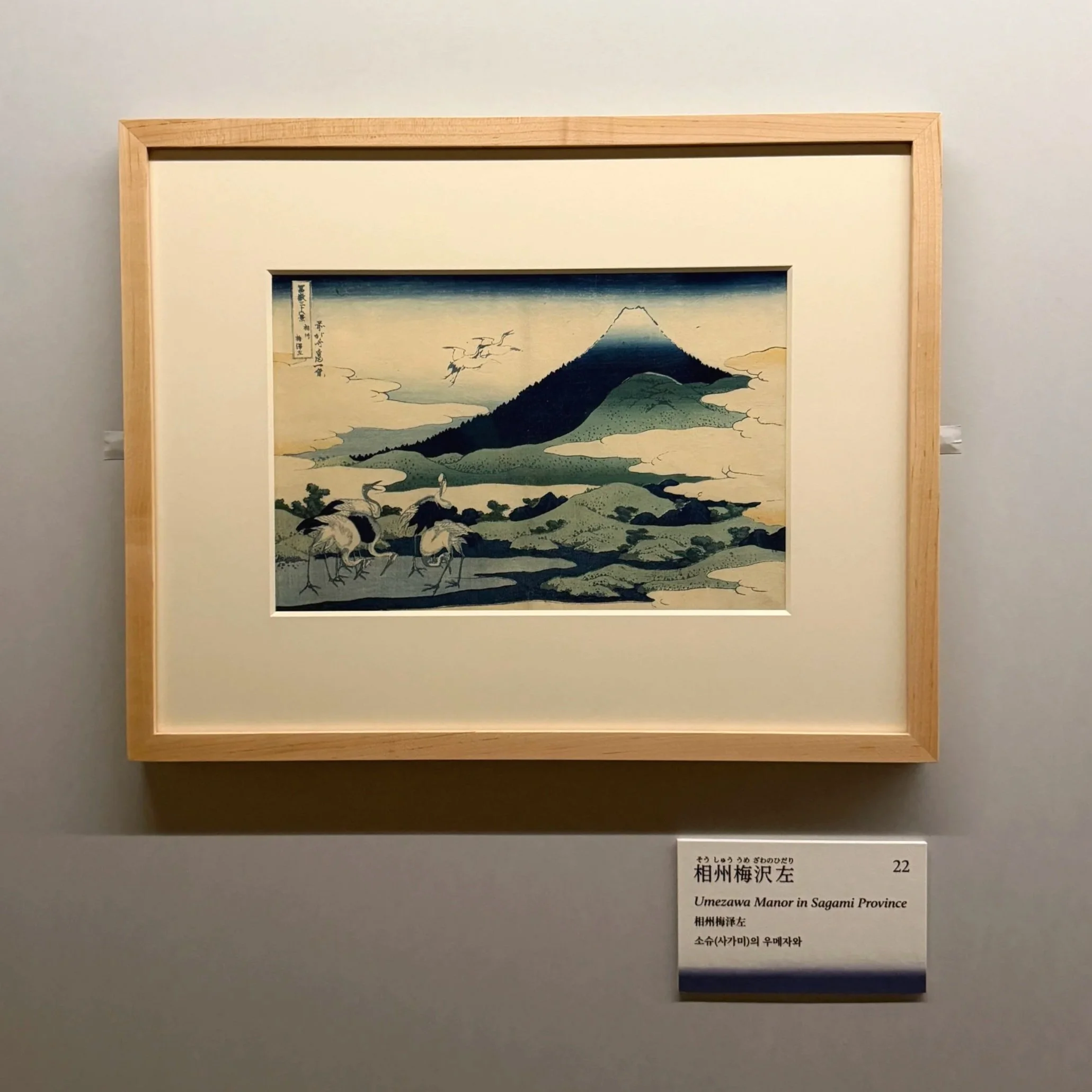
Umezawa Manor in Sagami Province by Katsushika Hokusai at the at the National Museum of Western Art

Laney Rogers, Jeanne Bourgogne, and Avery Bowers at Team Labs Borderless
Designing Across Cultures
Cultural exchange and collaboration with Japanese designers were an important part of the course. The students participated in two workshops at Japanese universities. The first, at Osaka Institute of Technology, challenged groups composed of NYSID students and Japanese students to design and build a cross-cultural bento box. The second, at Kyoto Institute of Technology, required students to design and present their idea for a temporary retail structure based on yatai, traditional Japanese mobile food stalls. Says Lubell, “The students used Google Translate, and in many cases, communicated their ideas across language barriers by exchanging sketches. The models were fabulous and cross-cultural - an American picnic basket with Japanese rice balls, for example. The quality of design the students were able to come up with in a day was astounding.” Some of these models are being shipped to NYSID for a temporary exhibition that will go up in the fall.
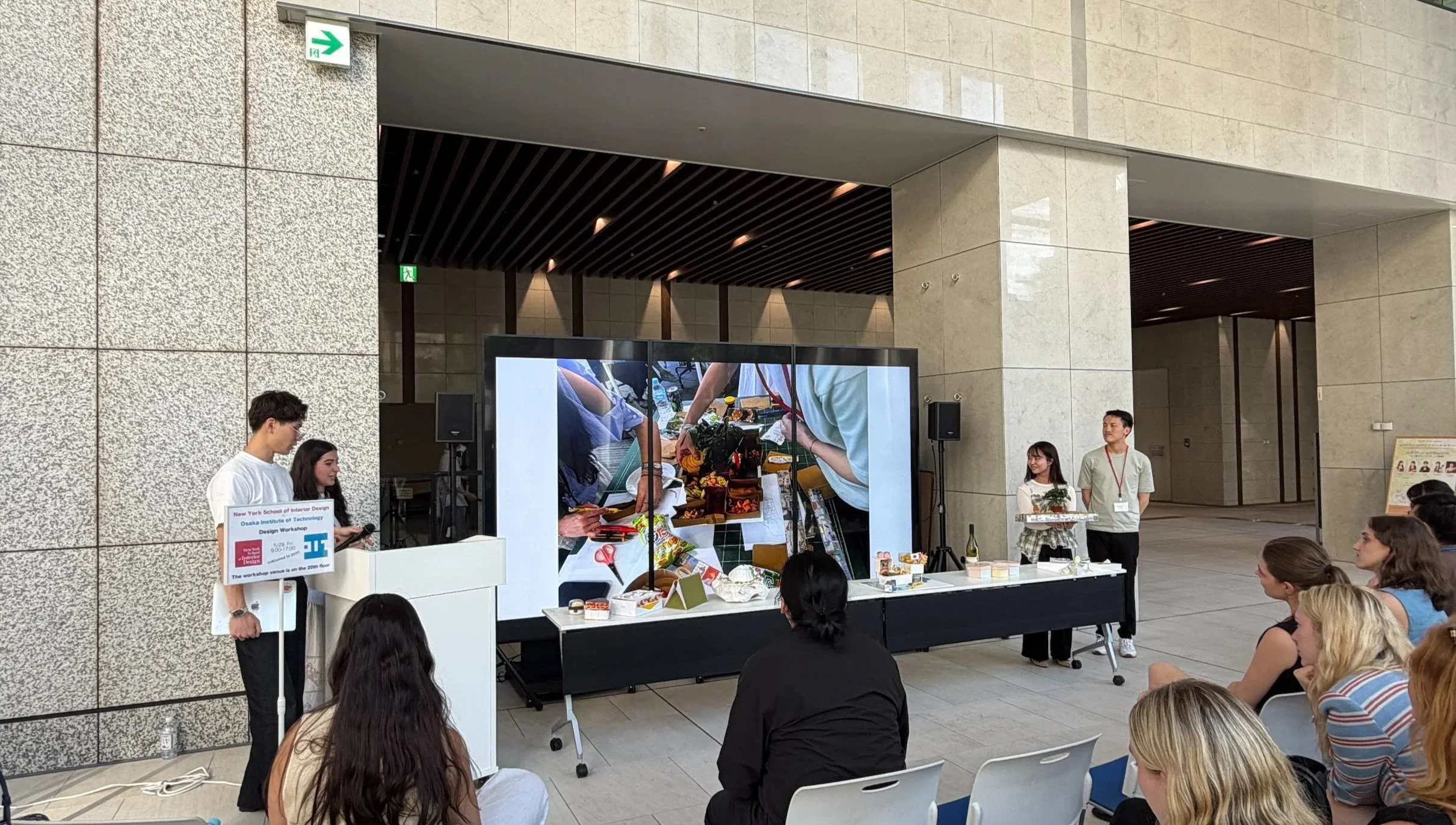
Mia Blavatnik, Peter Fisher, and two students from the Osaka Institute of Technology presenting their design of a cross-cultural bento box
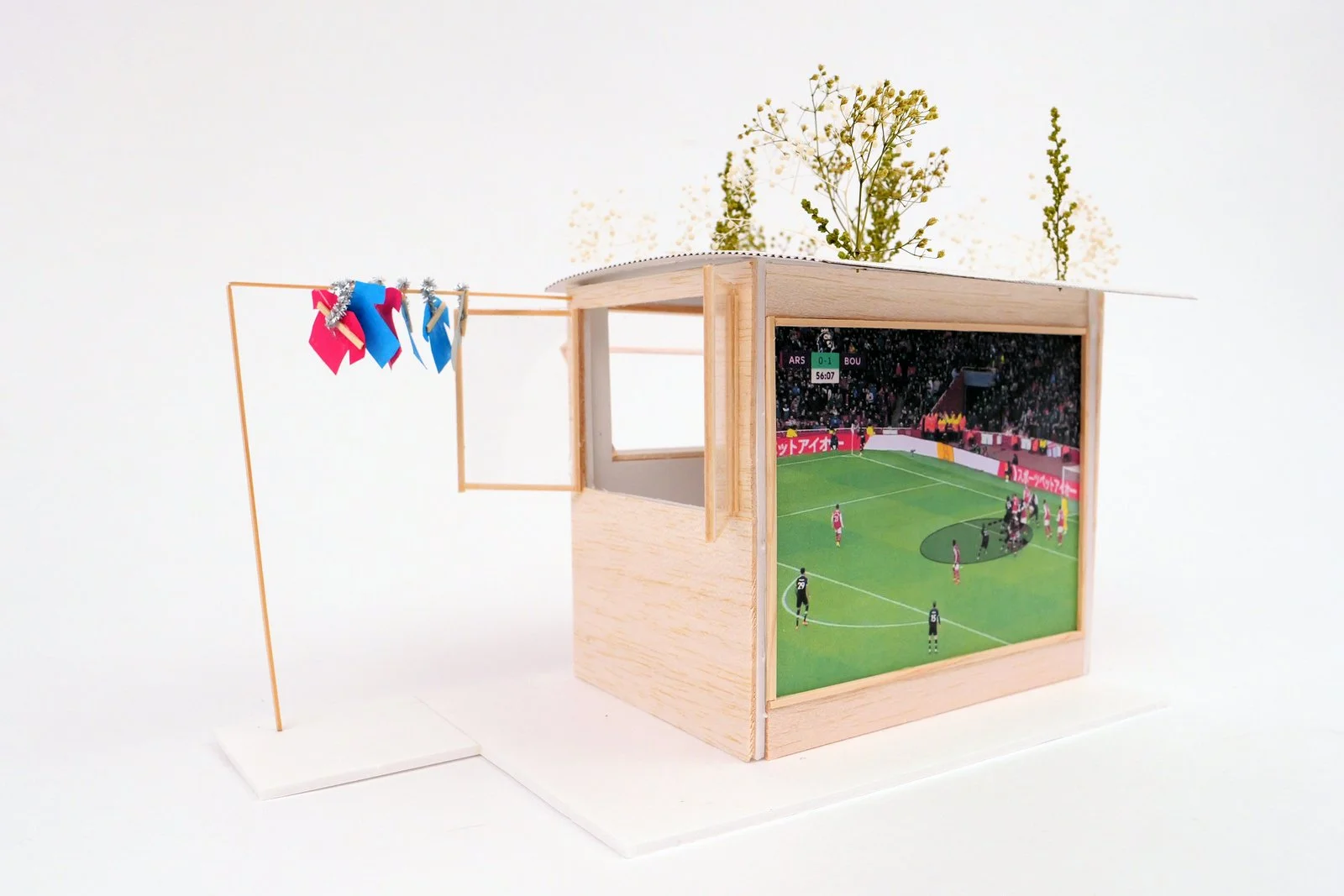
The Match Day Pub, designed by Julia-Kate Schamroth, Nicole Grabe, and Jackie Kletter (NYSID) in collaboration with Mako and Natsune (KYOTO Design Lab, Kyoto Institute of Technology)
A Special Instructor & Personalized Format
Students gave their instructor, Yutaka Takiura, glowing reviews. “Yutaka is very knowledgeable. What I appreciated most about him was the way he helped each of us learn through our own interests and perspectives,” said one of the Duffy awardees. “When we shared our thoughts with him, he would respond with his own insight and knowledge in a way that felt very open and natural. It did not feel like we were only being taught information; it felt like we were learning how to see. That is a very beautiful and meaningful way to teach design.”
Other Ways of Seeing
The emerging designers who traveled to Japan are just beginning to integrate all they learned and reflect on how they have changed as designers. For Qiu, a first-generation college student who grew up in a rural fishing village in China, the experience was profound because even though she is from China she never was exposed to Eastern design in a formal way. Qiu reflects, “Studying Western design taught me the importance of symmetry, alignment, form, and perfection. Japanese design showed me another way of thinking: design does not always have to be glamorous, polished, or completely new to be meaningful. In modern life, people often want to build bigger, newer, and more impressive spaces. Japan taught me to slow down and see beauty in what already exists—in age, simplicity, imperfection, and culture.”
Kosematoglu had a different focus and takeaway. “One of my main objectives on this trip was to learn more about seismic design in Japan and how this can be incorporated into interior design in areas with high seismic activity,” she says. “I realized that certain elements of Japanese interiors, which I previously considered just stylistic choices that reflect Japanese taste and culture, are also very practical in terms of seismic considerations.” She referenced the Sanjūsangen-dō, an ancient Buddhist temple in Kyoto, saying, “The foundations of the temple are laid on layers of sand and clay that function as an early form of base isolation. This ensures that the entirety of the kinetic energy of earthquakes is not transferred to the timber frame. The frame itself is a flexible timber structure that responds to seismic forces and dissipates energy.”
Says Fisher, “One element that is carried through the entire evolution of Japanese design is an emphasis on craft and structure. Seeing how thoroughly Japanese design incorporates and highlights craft and structure in its forms is something I am inspired to bring into my own designs.”
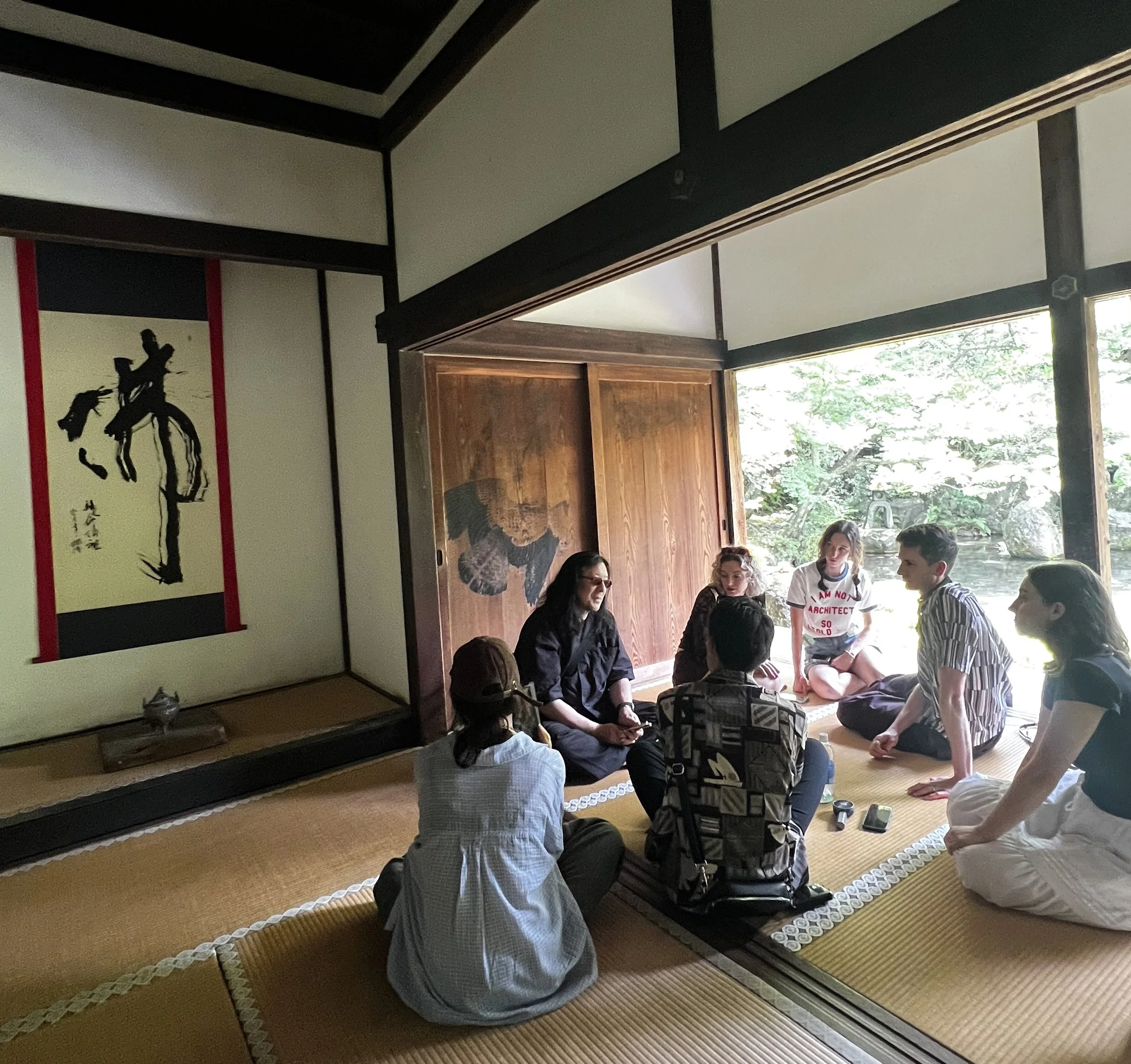
Yutaka Takiura with students at Renge-ji temple
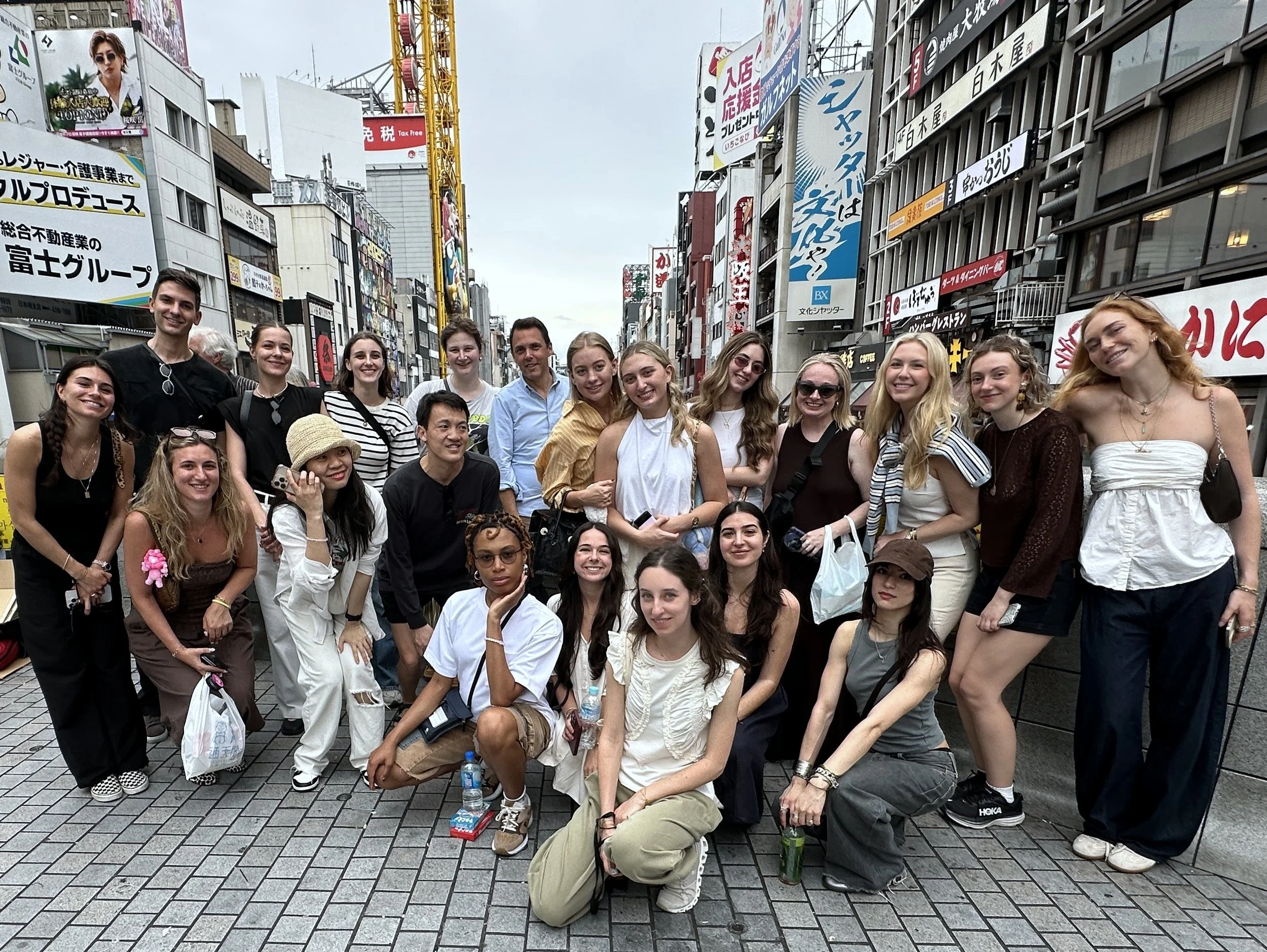
Study abroad group in Osaka
Travel Study Scholarships at NYSID
NYSID’s travel scholarships make study abroad possible for students who otherwise may not be able to afford it, and help the College create an equitable environment where all students have access to the best of a NYSID education. NYSID’s travel-study funds provide partial and full scholarships to the College’s Study Abroad Semester in Florence; scholarships to its 10-day to three-week travel-study courses, as well as grants for independent travel study. This spring/summer, there were trips to Southern California and Spain, in addition to Japan.
The Anne K. Duffy Fund for Non-Western Study Abroad is one of several NYSID travel-study funds, and it has been earmarked specifically for study abroad and independent study in Asia, Africa, and Latin America, at the behest of the Duffy family.
To discuss a donation to the Travel-study Fund or underwriting a scholarship for Study Abroad, reach out to Joy Cooper, NYSID’s Director of Development, at giving@nysid.edu or make a donation and designate “Scholarships - Travel” HERE.
Travel-study scholarship applications are open to all students with financial need who are in good academic standing, whether enrolled in an online or in-person degree program. NYSID will send out an announcement detailing the 2027 Study Abroad Semester in Florence in late summer, including directions on how to apply for scholarships. Interested students should reach out to the Office of Academic Affairs for more information at grace.lubell@nysid.edu.