
A Decade of NYSID’s Service Learning Studio
Terry Kleinberg on Her Students’ Social Impact
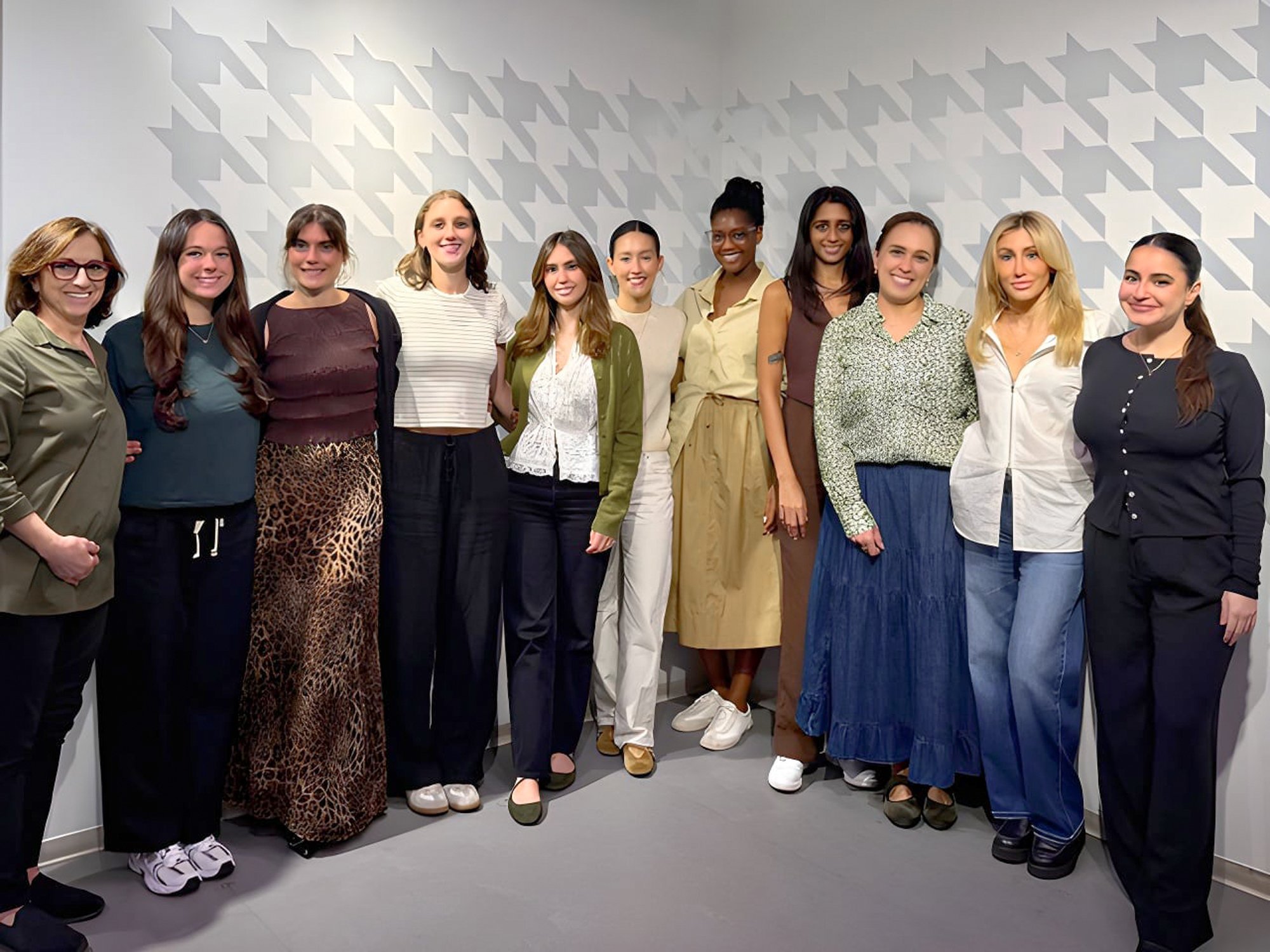
Instructor Terry Kleinberg and students Laney Rodgers, Soraya Meadowsweet, Julia-Kate Schamroth, Mariana Serrano, Lauren Cullen, Afua Rida, Niraly Patel, Patrizia Dalle Mule, Cassandra Rosselli, Stefanie T.
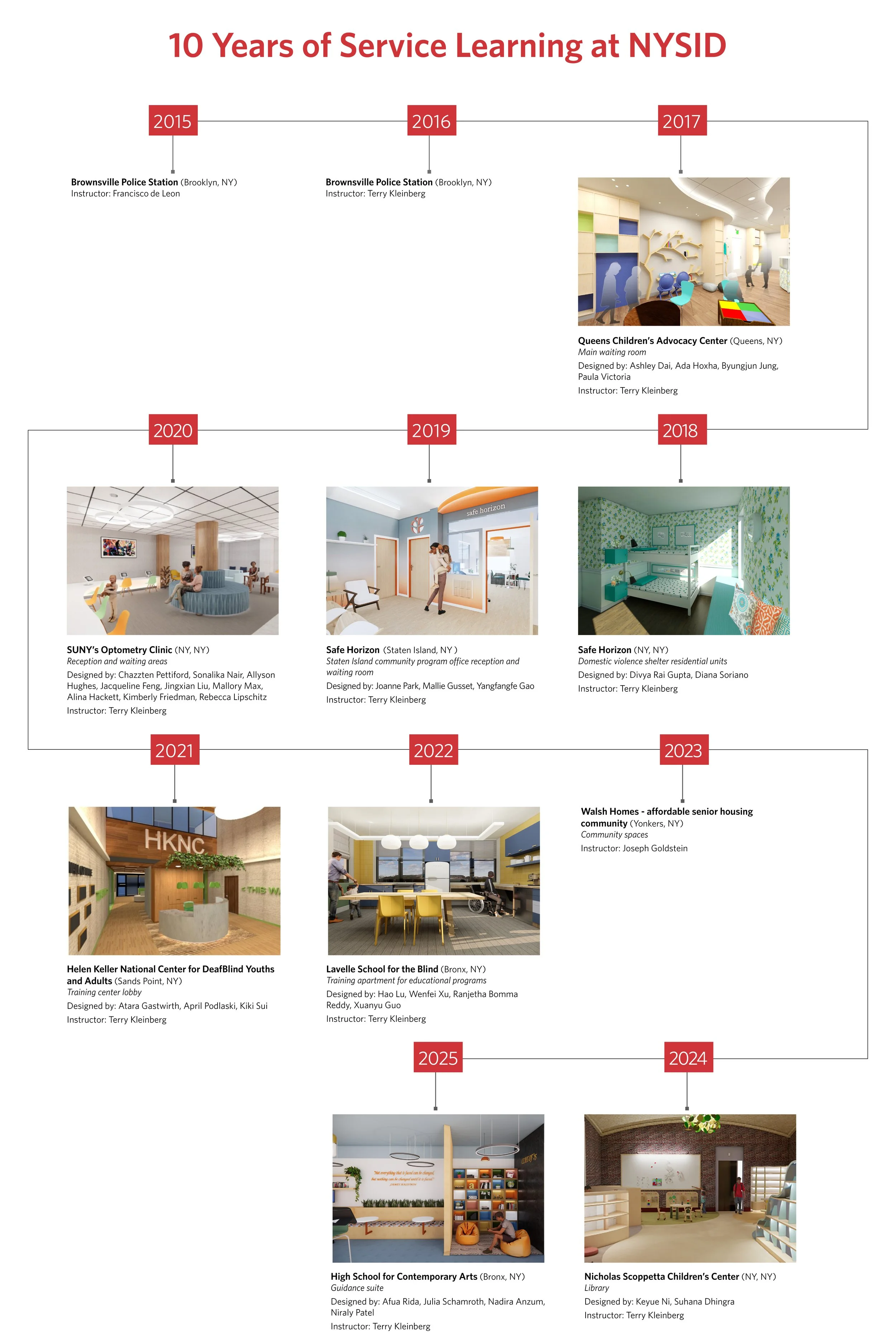
In 2015, NYSID Vice President for Academic Affairs and Dean Ellen Fisher and former Associate Dean Barbara Lowenthal created a summer Service Learning Studio to offer Master of Fine Arts in Interior Design (MFA1) students the opportunity to create real-world designs, for real clients. At first, there were just a handful of students in this course focused on experiential learning and designing for good. But in the summer of 2016, faculty member Terry Kleinberg, principal of a firm with an interest in designing interiors for nonprofit organizations, began teaching and further developing the program into an incubator for social justice design. Today, it’s a very popular course, despite, or perhaps because of, challenging projects NYSID students tackle. Service Learning students solve real-world problems by working with classmates as a team and lead the design process.
NYSID: Will you tell me more about your process of helping students throughout the course?
Terry Kleinberg: The first thing they do is a week of research about the organization and the demographic they will be designing for. This may not sound like much, but they're doing it full time [with] each [student having] a separate topic to present to the group. So, they're starting out with a base of some expertise and [then] get more from the client when they make their first site visit. As they're working, I see them only twice a week. I go desk to desk and work with each group [to] see what they're doing and try to guide them as I would [in] any other studio course. More than in regular studios, I try to hang back, because I think they really learn more when they play off each other and figure things out together. Obviously, I'm available to critique their work, but I really do try to let them take the helm and I help them implement what they're trying to do. We have a group of lighting students consult with them, so they can do a professional job on lighting, which is always important. I've had former students come in and teach them skills like making a video walk-through of their project. For the past several years, faculty member Eric Cohen, who has experience designing for groups with special needs, has acted as a guest critic and mentor when we have in-class pin-ups. So, I try to draw on people from the NYSID community who have the skills that they need to do their projects well. Aside from benefiting their projects, this exposes them to the common practice in an office of bringing in consultants with various areas of expertise to inform your projects.
How were you able to connect with willing organizations?
The first two summers we worked for the police station in Brownsville, Brooklyn, through a city organization that paired academic institutions with city agencies that had certain needs that the academic institutions could fill. We've had a few people come to us because they've heard about the program and would like us to work with them. Now that we have a track record, I can send examples of what we’ve done before, which always amazes them. At the same time, I need to impress upon the prospective clients that it’s a big time commitment for them. They have to assemble a group of people who will see the students’ work every two weeks during the eight-week term and give feedback; they have to give us a tour of their facility, explain their user needs and their demographic. While the client’s needs are a big priority, I also must be sure that the students will have a good experience and learn something in the process, and the client must be willing to do their part in this.
In a previous story for Atelier, you described the student’s work as “difficult and meaningful”. Can you talk about that more?
In Service Learning, students learn about all kinds of requirements that are necessary to accommodate the populations they are designing for. They don't really have the same constraints in purely academic studios, so having these real constraints is difficult. A lot of students go in thinking it's going to hamper their creativity, and they learn that it does the opposite. I mean, there's nothing that triggers creativity like having to solve a complicated puzzle. When they end up seeing what amazing designs they've done for such really challenging spaces and populations, they surprise themselves. Year after year, the clients are blown away by the results, and the students come away from the final presentation grinning with pride. We’ve gotten comments such as: “I never knew accessibility could be so beautiful” and “We’ve worked with professional designers who didn’t listen to us the way you have.”
How do you feel about celebrating 10 years of the course? What do you envision for years 10 and beyond?
I sound like a broken record talking about how much I love teaching service learning. I hope it will just keep going and I imagine it looking very much the same. One of the reasons I like mixing it up is because I get a different perspective, but for each group of students, it's a new experience. I'd be thrilled if we could fill two sections every summer. Mostly because of what I've learned, by teaching this for so long, I am doing some consulting for an organization in Uganda that's building schools for disabled children. My first thought was, Oh, we could take a group of students and go to Uganda where they could be so helpful. It’s not a realistic prospect for many reasons, besides which there's so much you have to understand about another culture to design there. So, it's tough, but I would love to see something like that, a study abroad/service-learning combination.
You've talked about how it's rewarding for you with the community and rewarding to see the students get energized and fired up about what their design can do. But I imagine that being an instructor, students are impacting you as much as you're impacting them. So, I'm curious to hear about why you've done it for almost 10 years?
My practice has largely been for clients of means. So, I think it helps me keep perspective and satisfies a need that I have to feel like I'm contributing something to a client and end-users who don’t otherwise have access to design. The education of the students is deeply meaningful to me, because it gives them a different perspective on how their skills as designers can have an impact on people’s lives. I've had students go through this course and, a year or two later, when they're graduating, look for work with a firm that does affordable housing or something similar. Then I know that [the course] rubbed off on them in a way that's lasting, and I think that's important. So, you know, it's giving me the joy of seeing the impact on my students and also filling a gap in my professional life at the same time.
What on the horizon for summer 2026?
Our service-learning team will work with Encore Community Services, a nonprofit organization that aims to help elders "age with dignity, living as independently and fulfillingly as possible.” They run two supportive housing facilities, one for lower-income seniors and one for formerly unhoused and/or mentally ill seniors. They also have two senior centers: a Lifelong Learning Center and the Aging Through Arts Center. The latter would be our space to design. The Aging Through Arts Center serves lunch every day and houses many activities as well as a staff who help with social services. They have a large kitchen and are moving most of it off-site, so they will devote additional space to administration and activities. They will require a “master plan” to reconfigure the space, which will be challenging and interesting.
Interested in the MFA1?
Research based design that has a social impact is core to every NYSID degree. NYSID’s Service Learning Studio is a unique feature of its Professional-level Master of Fine Arts in Interior Design (MFA1), and it fulfills the program’s summer experiential learning requirement. For information about the MFA1 or which academic program at NYSID is right for you, start HERE or reach out to admissions@nysid.edu.
Interested in Service Learning?
If you are a student already enrolled at NYSID with questions about Service Learning, please reach out to academicaffairs@nysid.edu.