Portfolio: Catriona Howard '25 (BFA)
The Office of Academic Affairs awarded Catriona Howard ’25 (BFA), whose thesis project is featured on this page, the Chairman’s Award winner for her overall performance at NYSID. At NYSID, thesis projects are long journeys that challenge students to brainstorm, conduct research, and synthesize all they have learned. The journey ends with a presentation to a jury of faculty and industry professionals. Our students work closely with faculty to create hypothetical designs that offer solutions to real-world problems.
Student: Catriona Howard
Project: Lekker Market - A South African Cultural Market: Reviving the Lost Art of Apprenticeships
Program: Bachelor of Fine Arts
Instructor: Jack Travis
For her thesis, Chairman’s Award winner Catriona Howard designed Lekker Market, a culturally immersive South African market in Williamsburg, Brooklyn, which she envisioned as a space where craft, cuisine, and community intersect. More than just a retail environment, the project is rooted in reviving the art of apprenticeships and pushing back against mass consumerism by centering local, hand-crafted goods.
Howard’s concept grew from both research and personal history. Her early exposure to African culture came through her father’s upbringing across different parts of the continent, which filled her home with crafts, photographs, and stories from the region. On a trip with NYSID to India, she observed how culture is expressed through both architecture and interiors. Together, these influences informed her thesis as an opportunity to understand and celebrate South African culture while responding to her generation’s renewed interest in lost arts.
Rather than attempting to represent all South African tribes or motifs directly, Howard focused on the commonalities shared between their traditions. The core design concept explores the juxtaposition between organic curves and rigid angles, representing the coexistence of nature and structure, softness and sharpness, and fluidity and order. This approach allowed the interiors to showcase the vendors’ work without overwhelming it, creating a backdrop that supports a wide range of crafts and materials.
The Williamsburg site was chosen for its diverse, artistic culture. Howard expanded the footprint to include corner access and two floors to accommodate apprentices’ on-site housing. The program includes food and merchandise markets on the lower levels, with housing, a South African library, coffee shop, and rooftop above. With no singular end user, the design carefully balances the needs of apprentices, vendors, and daily visitors while maintaining privacy and security where required.
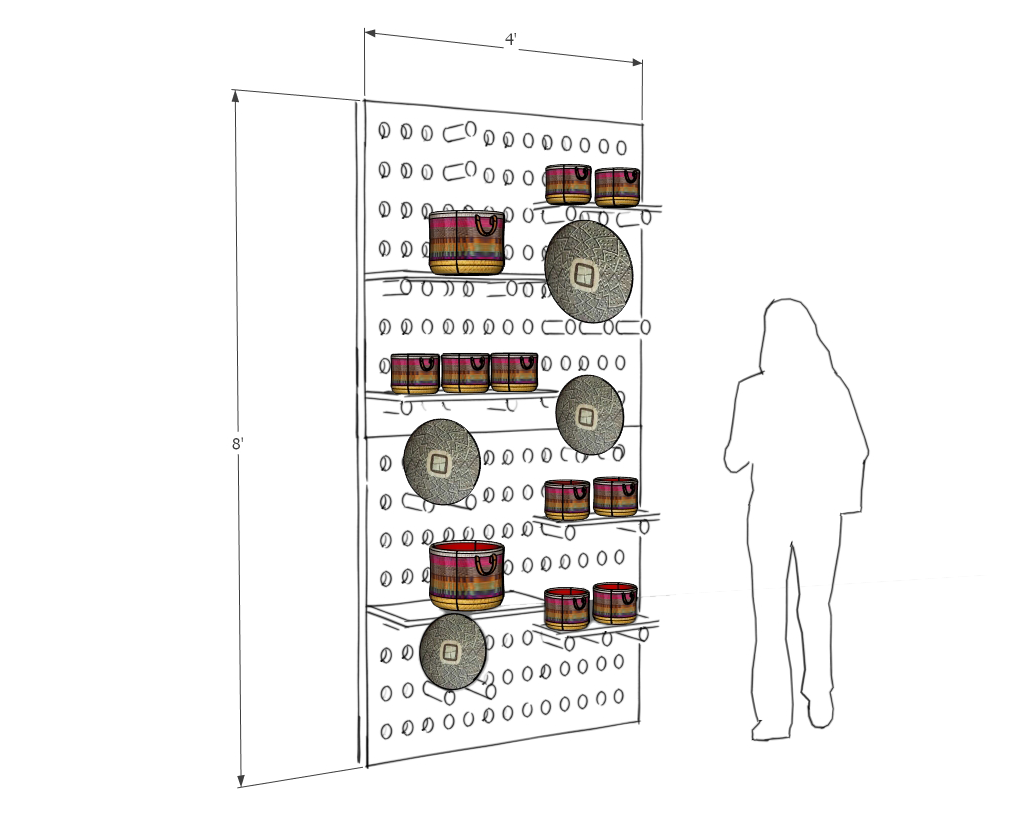
A central building core anchors the project, with elevators wrapped in biophilia and circulation unfolding around it. Windows act as “lookout” points to evoke curiosity between user groups, while impluvium-inspired ceilings, a communal “water hole”-style coffee shop, and flexible pegboard-based vendor systems reinforce connection, adaptability, and sustainability. Together, these elements create a market that functions as a living ecosystem of creativity, tradition, and community.
Following her graduation, Howard has been working as an interior designer at The Lowell Hotel.
— Uzma Nur (MFA1 student)