Portfolio: Christianna Theofanopoulou '25 (MFA2)
The Office of Academic Affairs awarded Christianna Theofanopoulou '25 (MFA2), whose thesis project is featured on this page, the Chairman’s Award for her overall performance at NYSID. At NYSID, thesis projects are long journeys that challenge students to brainstorm, conduct research, and synthesize all they have learned. The journey ends with a presentation to a jury of faculty and industry professionals. Our students work closely with faculty to create hypothetical designs that offer solutions to real-world problems.
Student: Christianna Theofanopoulou
Project: The AI-driven Department Store
Program: Master of of Fine Arts (Post-Professional)
Instructor: Stefanie Werner
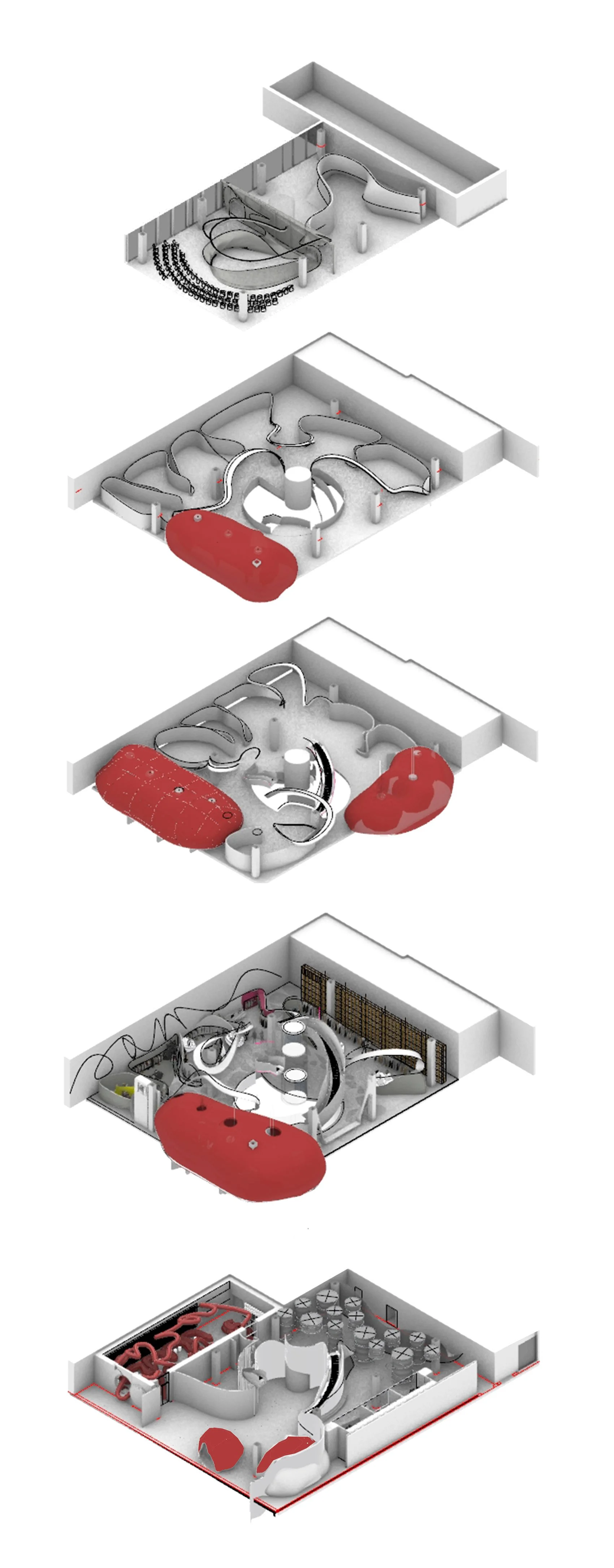
With her vision of an AI-driven department store, Christianna Theofanopoulou upended the traditional “static” model of retail space by envisioning a “hyper-personalized” interior that offers a journey of self-discovery and self-expression. “I researched AI-driven recommendation systems and behavioral algorithms, examining how digital platforms anticipate user desire,” she says. “Rather than replicating this logic through screens, I translated it architecturally. Circulation, lighting, compression, and spatial sequencing became physical manifestations of algorithmic personalization.” The space and experience morph to suit the user, who Theofanopoulou envisioned as “the hyperaware, digitally fluent individual accustomed to algorithmic personalization in daily life.” She adds, “This user expects more than selection. They expect recognition.”
The project is situated within the footprint of the historic Manufacturers Trust Company Building on Fifth Avenue in Manhattan, a Modernist landmark. She organized the building as a narrative ascent: 1. ground floor: exhibition, data collection, café, personalization robots; 2. middle floors: synthetic cocoons and physical shopping; 3. penthouse: runway and backstage. The user is meant to ascend from a collective experience to a personalized encounter and finally to a public performance. One of the most visionary aspects of this design is the synthetic cocoons: adaptive fitting rooms that inflate and respond to each individual’s body. Materials research was key. “I investigated pneumatic and inflatable architecture, studying how air can function as structure,” says Theofanopoulou. “This informed the development of the latex cocoons and their inflate–deflate mechanism. The flexibility of pneumatic systems allowed the architecture to feel responsive and alive, rather than fixed.” The artist Anish Kapoor, whose work manipulates perception, reflection, and spatial ambiguity, influenced the aesthetics and reflective quality of the cocoons. The fitting rooms are not the only aspect of the architecture that morphs. There is also “a continuous tentacle-like structural system that originates at the staircase and extends throughout the building,” says the designer. “These elements appear as branching, crawling forms that move along the path of the user. They function as the visible presence of AI within the space, shifting light, directional emphasis, and motion according to the customer’s curated profile.” Sun Her advised Theofanopoulou as a mentor on the project. Theofanopoulou is currently based in Athens, Greece, working at Tsolakis & Partners.
— Jennifer Dorr